How to Charge for AI Work
Hourly billing is dying and clients won't pay for prompts. Three ways to price AI-assisted work — and what makes any of them defensible.
How to Charge for AI Work
"By 2028, we'll double profits and halve the people."
That's not a tech disruptor talking. It's the CEO of a global agency holding company, quoted in Forrester's Predictions 2026: Marketing Agencies — describing their own business.
Half the people. Double the profit. There's only one way that arithmetic works: the hours × people × rate model — the thing agencies have billed on for sixty years — stops being the unit of sale.
Which leaves every agency owner with the question that lands right after a good AI demo: if the work that took thirty hours now takes four, what do I invoice?
The Efficiency Dividend Has to Go Somewhere
Forrester's headline prediction is a 15% reduction in agency jobs in 2026, on top of average 8% cuts in 2025. Their analysts describe agencies pivoting from selling services to selling solutions — outcome-based pricing, fixed fees, productised offerings. We unpacked the full analyst picture in What Analysts Predict for Agency AI.
Deloitte's State of AI in the Enterprise, surveying 3,235 leaders across 24 countries, shows why that pivot is harder than it sounds: 66% of organisations report productivity gains from AI — but only 20% report actual revenue growth. The productivity is real. The money isn't following.
That 46-point gap is the pricing problem in one statistic. Most organisations capture AI's value as cost savings — which, for an agency billing by the hour, means handing the saving to the client for free and keeping the pay cut for yourself.
Nielsen Norman Group's meta-analysis of AI productivity studies found gains averaging 66% across writing, support and coding tasks. Good news — until you do the billing maths. If you charge by the hour and get 66% faster, you've just given yourself a 40% pay cut. The efficiency dividend is real. The only question is who keeps it.
HBS professor Karim Lakhani frames the shift as AI lowering the cost of cognition the way the internet lowered the cost of transmitting information. When the cost of the thing you sell collapses, you sell more of it, sell something else — or sell it differently. Agencies are in the third camp.
What This Looks Like on a Tuesday
Consider a brand strategist with a retainer client. The monthly strategy refresh used to take thirty hours. With AI handling the research synthesis and first-draft analysis, it now takes four.
Your instinct says honesty matters, and it does — but honesty about hours is the wrong frame. The client was never buying hours. They were buying the refresh. The hours were just how everyone used to measure it.
Three options:
- Bill thirty hours. Dishonest — and clients aren't stupid. This works until the day someone shares a screen with an AI tab open, or a deliverable arrives suspiciously fast.
- Bill four hours. Honest — and you can't make payroll. You absorbed the entire productivity gain as a price cut, and trained the client to expect it forever.
- Change what you're selling. The conversation you've been avoiding.
Most agencies are stuck oscillating between options one and two, hoping the question never gets asked out loud. Meanwhile, it's already being asked. Enterprise procurement teams have started putting AI questions into RFPs — how much of the work is AI-assisted, and why doesn't the price reflect it. Forrester's B2B predictions report warns that ungoverned AI use will cost B2B companies over $10 billion, and tells the story of a global consulting firm refunding a client hundreds of thousands of dollars after a deliverable shipped with AI hallucinations. Buyers are jumpy. Jumpy buyers negotiate.
If you don't have a pricing answer, procurement has one for you: a discount.
The question isn't whether AI changes your pricing — it already changed your costs. The question is whether you capture that change or donate it.
Three Pricing Models, Honestly Assessed
1. Hourly plus AI — the default, and it's dying
Keep billing hours. AI shrinks the hours. Revenue shrinks with it.
This model is simple and honest, and it has one fatal property: it converts every capability improvement into a pay cut. Your fastest person produces your smallest invoices. Every tool you adopt makes the problem worse. It also creates a quiet temptation to pad timesheets — which is how agencies slide into option one above without ever deciding to.
Where it still works: genuinely exploratory work where scope is unknowable — early research, discovery phases. For defined deliverables, it's a slow leak.
Other industries have lived through this. When desktop publishing collapsed the cost of typesetting, the print shops that survived weren't the ones that kept charging by the keystroke — they were the ones that started charging for the brochure. Same skill, new unit of sale. Agencies are having their typesetting moment.
2. Fixed-fee — viable now, with a condition
Price the deliverable, not the hours. Strategy doc: $8,000. How long it took is your business.
This is where the efficiency dividend becomes margin instead of a pay cut — and it's where most agencies should be moving now. The condition: fixed-fee plus AI reads as corner-cutting unless the client trusts the process. "Why does this cost $8k if ChatGPT wrote it?" is a fair question. It has a good answer — expertise in the brief, judgment in the edit, accountability for the result — but the answer only lands if you can show the work behind the work.
McKinsey's research on AI adoption keeps finding the same thing: the organisations capturing value from AI rebuilt the workflow around it, rather than bolting it onto the old process. Pricing is part of the workflow.
3. Outcome-based — where it's heading
Price tied to results: uplift, conversion, pipeline. This is the pivot Forrester describes, and the endgame of "sell solutions, not services."
The upside is real — margins decouple from effort entirely. So are the catches: you need attribution you can defend, results arrive on the client's timeline rather than yours, and outcomes depend partly on client execution. Treat it as a direction, not a switch.
Notice what models two and three have in common: they both run on proof. You can only price on the deliverable, or the outcome, when you can demonstrate what went into producing it. Verification isn't a compliance nicety — it's the thing that makes the price defensible.
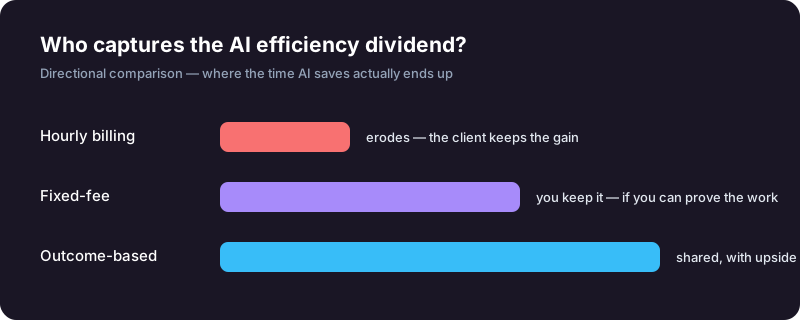
| Client pays for | Efficiency dividend | Main risk | |
|---|---|---|---|
| Hourly + AI | Your time | The client keeps it | Revenue shrinks with every tool you adopt |
| Fixed-fee | The deliverable | You keep it | Looks like corner-cutting without proof |
| Outcome-based | The result | Shared, with upside | Attribution fights and slow payment |
What "Solved" Looks Like
The agencies holding their margins through this shift share one trait: they can show their work. Not "trust us, we're experts" — evidence. Which research informed the strategy. Which brand rules shaped the copy. Which data the analysis actually ran on.
When the client can see that, "why does this cost what it costs?" has a concrete answer — and the conversation moves from hours to value. As we found when looking at the ROI of verifiable AI, the client who sees the provenance trail doesn't ask for the AI discount. They ask what else you can do.
The pricing conversation itself gets easier with evidence behind it. "Our fee is $8,000 for the refresh. Here's what goes into it: your current brand materials, the latest market data, our analysis framework — and here's the record of exactly what informed the work." That's not a defence. It's a specification. Clients push back on prices they can't see inside; they sign specifications.
Platforms like Vythos exist to make that proof cheap — each client's knowledge in its own workspace, a record of what informed every output — but the principle is older than any tool: provable work commands better prices than opaque work.
The practical move is small. Don't reprice everything — reprice one thing.
Retainers are the place to start, because they're where the hourly fiction is most exposed. A retainer that says "30 hours of strategy per month" invites the four-hour question. A retainer that says "the monthly strategy refresh, plus a quarterly deep-dive, with a record of what informed each" prices the deliverable instead. Same work. Different unit of sale.
Pick your most trusting retainer client. Convert at the next renewal: same fee, restated as deliverables, verification trail attached. Learn what the conversation feels like when you can show the work. Then do it again.
The Honest Trade-Off
Repricing mid-relationship is awkward, and some clients — procurement-driven enterprise especially — will demand the AI discount whatever you show them. That's their job. Outcome-based pricing also needs measurement infrastructure most small agencies don't have yet; pretending otherwise is how agencies end up arguing about attribution instead of getting paid.
And if you're a solo consultant with two clients, skip the framework. Just quietly charge for value and spend the framework time on the work.
The One Thing
AI didn't just change how agency work gets done — it changed what an hour is worth. The agencies that keep their margins won't be the ones that hid AI from the invoice. They'll be the ones who can prove exactly what the price pays for.