What Analysts Predict for Agency AI
What Gartner, McKinsey, and Forrester actually say about AI in professional services and what it means for your agency.
What Analysts Predict for Agency AI
Lots of people have opinions about AI in agencies. Most of them are selling something.
So instead of more hot takes, here's what the people who get paid to be right — Forrester, Deloitte, McKinsey, Gartner — are actually predicting. Specific reports. Named sources. Real numbers.
Some of it is encouraging. Some of it is brutal. All of it matters if you're a freelancer, consultant, or small agency owner.
Forrester: 15% of Agency Jobs Gone by End of 2026
Forrester's Predictions 2026: Marketing Agencies report doesn't soften the blow. The title — "Marketing Agencies Resign Their Agency" — sets the tone.
The headline number: a 15% reduction in agency jobs in 2026. That's on top of an average 8% cut in 2025. Not a slow fade. A structural collapse of the old billing model.
One global holding company CEO put it bluntly, in a quote Forrester found striking enough to highlight:
"By 2028, we'll double profits and halve the people."
That's not a tech disruptor saying it. That's the CEO of an agency holding company talking about their own workforce.
The mechanism is straightforward. AI and automation are gutting the labor-based economic model — hours × people × rate — that agencies have run on for decades. When AI handles in minutes what used to take a junior team member a day, billing for time stops working. Forrester sees agencies pivoting from selling services to selling solutions: outcome-based pricing, fixed fees, productized offerings.
Meanwhile, 85% of US B2C marketing executives plan to review their media agencies in 2026. Forrester predicts more Omnicom-IPG-scale acquisitions — potentially Havas acquiring dentsu's international operations, or WPP restructuring for a sale — which will only accelerate those reviews.
What this means for you: If you're solo or running a small shop, this is better news than it sounds. The big agencies are restructuring around technology platforms and scaled media buying. That creates openings for specialists who bring deep client knowledge and a real system for making AI work verifiably. Clients leaving the holding companies aren't looking for another platform. They're looking for someone who actually knows their business.
Forrester: The $10 Billion Trust Problem
A second Forrester report — Predictions 2026: B2B Marketing, Sales, and Product — puts a dollar figure on the governance gap.
Ungoverned genAI in commercial applications will cost B2B companies more than $10 billion in enterprise value. Stock price declines. Legal settlements. Fines.
Forrester cites a concrete example: a global consulting firm refunded hundreds of thousands of dollars to a client after a deliverable contained AI hallucinations and "slop." That's a Big Four firm, with armies of quality-assurance people, getting caught shipping AI-generated garbage to a paying client.
Two more predictions from the same report:
- Employees outside centralized content teams will create two-thirds of B2B content by end of 2026. GenAI puts creation in everyone's hands. Without guardrails, brand dilution is inevitable.
- 75% of enterprise B2B companies will increase influencer and analyst budgets. When AI generates content everywhere, buyers turn to trusted humans for reliable insight. Trust becomes the scarce resource.
What this means for you: Your clients are hearing about this problem. They're worried about unverified AI output — and they should be. If you can show exactly what context informed your work — what documents were used, which version, what rules applied — you have an advantage most agencies, including the large ones, can't match yet.
Deloitte: Everyone Has AI. Almost Nobody Is Transforming With It.
Deloitte's State of AI in the Enterprise 2026 surveyed 3,235 leaders across 24 countries between August and September 2025. The findings paint a picture of widespread adoption with shallow impact.
Worker access to AI rose by 50% in 2025. The tools are everywhere. That's no longer the bottleneck.
The bottleneck is what people do with them:
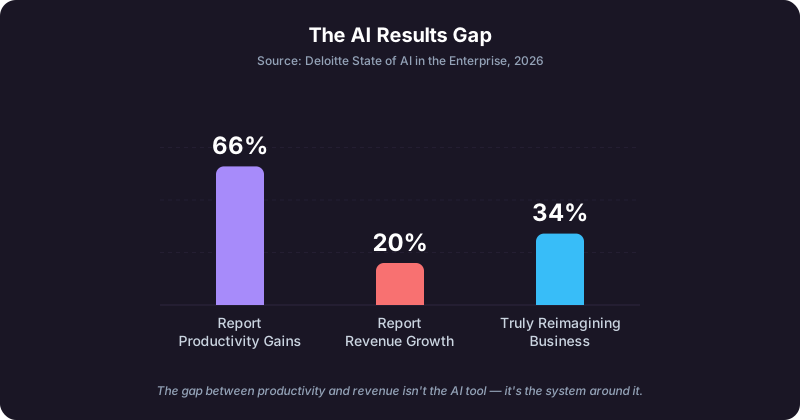
- 66% of organizations report productivity and efficiency gains. Good.
- Only 20% report actual revenue increases. 74% hope to grow revenue through AI. Hope is not a strategy.
- Only 34% are truly reimagining their business. The rest are doing surface-level optimization — faster versions of the same broken processes.
The skills gap is the number-one barrier to integration. But here's the catch: education — not role redesign, not workflow restructuring — was the primary way companies responded. They're teaching people about AI without changing how work actually gets done.
The Agentic AI Governance Gap
The most striking Deloitte finding for agencies: only one in five companies has a mature governance model for autonomous AI agents. Yet agentic AI usage is "poised to rise sharply in the next two years."
Eighty percent of companies have no real plan for overseeing AI that acts independently. And they're about to deploy a lot more of it.
Deloitte also found that 42% of companies believe their AI strategy is highly prepared — but they feel less prepared than last year on infrastructure, data, risk, and talent. Confidence up. Actual readiness down. That gap is where expensive mistakes happen.
What this means for you: When 66% get productivity gains but only 20% see revenue growth, the difference isn't the AI tool — it's the system around it. Your memory, your rules, your client context, your verification. The freelancers and agencies who build that system are in the 20%.
McKinsey: The "Superagency" Thesis
McKinsey's January 2025 report Superagency in the Workplace argues that AI's biggest impact isn't replacing workers. It's giving individual workers dramatically expanded capabilities. They call it "superagency."
Their annual Global Survey on AI — running since 2017 — has tracked adoption climbing from roughly one in five organizations to well over two-thirds. The adoption rate isn't the story anymore. The story is who captures value from that adoption and who just adds another subscription cost.
McKinsey's consistent finding: organizations that embed AI into core workflows see multiples of the return compared to those that bolt it onto existing processes. For professional services, they highlight knowledge management and client delivery as the highest-impact use cases.
What this means for you: "Superagency" is a McKinsey word for something freelancers already feel: one person with the right setup can deliver what used to require a team. The operative phrase is "the right setup." A chatbot you paste context into isn't a system. Rules that persist across clients, memory that carries forward, proof that the right information was used — that's what turns a solo practitioner into a superagency of one.
Gartner: Agentic AI Is the #1 Strategic Trend for 2026
Gartner named agentic AI their number-one strategic technology trend for 2026. They predict a third of enterprise software applications will include agentic AI by 2028.
Agentic AI means AI that doesn't just answer questions — it takes actions. Books meetings. Sends follow-ups. Updates project trackers. Makes decisions within defined boundaries.
For agencies, this is a double-edged sword. Agentic AI can handle the administrative work that eats 30-40% of a small agency's week. But your clients' in-house teams get the same capability. The value of "we'll handle that for you" drops when everyone's AI handles it.
What this means for you: The value proposition shifts from execution to judgment. Not "we'll write your emails" but "we'll make sure AI writes the right emails, using your current brand voice, your latest pricing, your approved messaging — and we can prove it." Execution is getting commoditized. Verified, context-aware execution is not.
Five Things Every Analyst Agrees On
Different firms, different frameworks, different methodologies. But five themes show up in every report:
- AI adoption is table stakes. Everyone has it. What you build around it determines whether you profit or just pay for it.
- The skills gap is misunderstood. It's not about knowing how to prompt. It's about building systems — rules, memory, verification — around the prompting.
- Governance is dangerously behind. Forrester's $10 billion prediction, Deloitte's one-in-five maturity stat — the guardrails haven't kept up with the tools.
- Trust is the new competitive moat. When AI-generated content is everywhere, provenance and proof of quality become what clients pay a premium for.
- The agency model is being restructured. Not dying. Restructured. From labor billing to outcome pricing. From service provider to solution provider.
The Small Agency Advantage
Here's what the analysts don't say outright, but their data implies: this restructuring favors the small.
The holding companies are cutting 15% of staff and racing to become technology platforms. They're managing client reviews, consolidation uncertainty, and the challenge of transforming a labor-based model while keeping the lights on.
You don't have those problems. You have different ones — wearing too many hats, managing context across clients, proving your AI-assisted work is reliable. But those are solvable problems.
Deloitte says only 34% of organizations are truly reimagining with AI. Forrester forecasts 15% agency headcount reduction. McKinsey says the gap between AI leaders and laggards is widening fast.
The through-line: AI rewards depth over scale. A solo consultant who knows a client's business and has a system for making that knowledge work with AI will consistently outperform a holding company trying to productize the same thing across a thousand accounts.
The One Thing
Every analyst report published this year converges on one uncomfortable truth: having AI is no longer the advantage. The only gap that matters now is between people who use AI as a tool and people who've built a system around it.
Rules that persist. Memory that compounds. Proof that it worked.
That's the prediction worth paying attention to.