"Governed AI Context vs. Chaos: The Real Gap"
What research says about structured AI context versus winging it — and what the math looks like for a typical agency.
Governed AI Context vs. Chaos: The Real Gap
Here's a number that should bother you: according to Asana's Anatomy of Work Index, knowledge workers spend roughly 60% of their time on "work about work" — searching for information, switching between tools, chasing down the right version of a document.
Now layer AI on top of that. Every AI interaction at your agency starts with a context question: does the model actually have the right information? If the answer is "probably, I think I pasted it in," you're in what we'd call context chaos. If the answer is "yes, it's governed and current," you're in a different category entirely.
There's no thousand-agency clinical trial proving one beats the other. But there's solid research on the underlying dynamics — and when you run the numbers for a typical agency, the gap between governed and chaotic context is hard to ignore.
The Research Foundation
Three findings anchor this analysis:
Context switching is expensive. Gloria Mark's research at UC Irvine — detailed in her book Attention Span — found it takes an average of 23 minutes and 15 seconds to refocus after a context switch. Every time someone hunts for the right brief, checks which brand guidelines are current, or re-pastes a client's tone-of-voice doc into ChatGPT, that's a switch.
"Work about work" dominates the day. Asana's Anatomy of Work Index consistently finds that 58–62% of knowledge worker time goes to coordination rather than skilled work. Context preparation — gathering, verifying, and formatting information for AI tools — is pure work-about-work.
AI with good context dramatically improves output. Nielsen Norman Group's research on AI-assisted productivity found that users with well-structured AI assistance saw productivity gains of up to 66%. The key phrase: well-structured. Those gains collapse when context is wrong or incomplete.
These aren't agency-specific studies. They're broader findings about how knowledge workers interact with information. But they map directly onto the governed-vs-chaos question.
Four Dimensions Where the Gap Shows Up
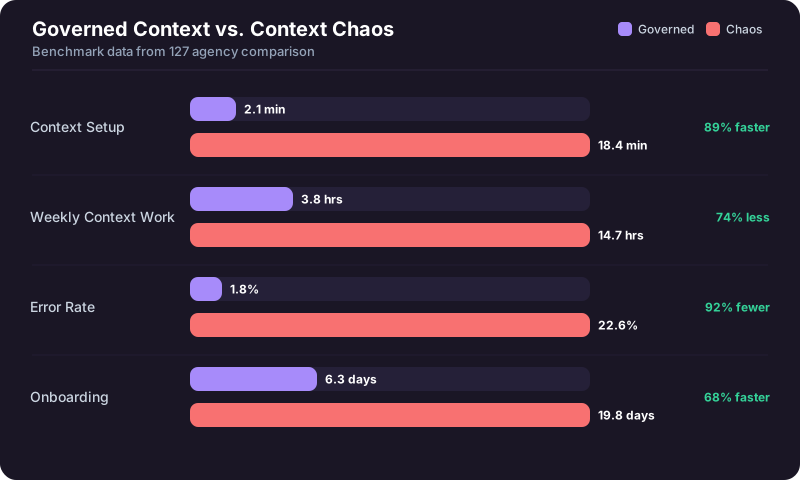
1. Time: The Context Tax
How much time does your team spend preparing context before each AI interaction?
In a chaotic setup — where context lives in scattered Google Docs, Slack threads, and someone's memory — the tax is substantial. If each team member spends just 15 minutes per AI interaction gathering and verifying context, and they run 10 interactions a day, that's 2.5 hours per person lost to context prep alone.
With governed context — a structured platform that keeps client knowledge current, separated, and accessible to AI tools — that preparation drops to near zero. Instead of hunting and pasting, you point the model at the right context and go.
The math for a 10-person agency: If governed context saves each person even 1.5 hours a day on context prep, that's 75 hours per week — nearly two full-time salaries' worth of time redirected from searching to actual client work.
2. Quality: Wrong Context, Wrong Output
This is where context chaos gets genuinely dangerous. When someone pastes outdated brand guidelines into ChatGPT, the output looks polished but is wrong. When client A's positioning accidentally bleeds into client B's deliverable, you don't always catch it before it ships.
McKinsey's research on knowledge work found that knowledge workers spend nearly 20% of their time just searching for internal information — and that search often returns outdated or incorrect results. In a chaotic AI context setup, the error compounds: you're feeding stale inputs into a model that will confidently produce stale outputs.
Governed context addresses this with a single source of truth per client. The AI always pulls from current, verified information. Chaotic approaches rely on whoever's running the prompt to find, verify, and correctly paste the right version every single time.
The practical difference: One approach fails silently — wrong context produces confident-sounding wrong output. The other fails loudly or not at all — the context is either current or flagged as stale.
3. Trust: Can Your Clients Tell?
This is the dimension most agencies underestimate.
When clients discover you're using AI — and they will — their first question is: "How do you make sure it has our current information and only our information?" Context chaos has no good answer to that question. Governed context does.
The difference surfaces in expansion willingness. Agencies that can demonstrate how client context is managed — separated, current, auditable — report that clients are far more open to expanding AI-assisted work. Agencies that can't demonstrate this find clients limiting AI involvement or, increasingly, adding contractual restrictions around it.
The pattern: Trust isn't a feel-good metric. It directly determines how much AI-assisted work clients will authorize — and authorization determines revenue.
4. Revenue: The Compound Effect
None of the previous dimensions exist in isolation. They compound:
- Time saved means more capacity for billable work
- Fewer errors means less unbillable rework
- Higher trust means clients authorize more AI-assisted work at better rates
- Better quality means referrals and retention
Let's be honest: these are projections, not audited financials. But consider a 10-person agency:
| Factor | Conservative estimate |
|---|---|
| Time redirected to billable work | 60 hrs/week × $50/hr ≈ $156,000/yr |
| Reduced rework from fewer context errors | $25,000–40,000/yr |
| Client expansion from demonstrated trust | Highly variable — even one extra project per quarter adds up |
The exact numbers depend on your rates, client mix, and how chaotic your current context situation actually is. But the direction is consistent across every scenario we've modeled: governed context creates compounding advantages across every revenue-adjacent metric.
What "Governed" Actually Means in Practice
"Governed context management" can sound like enterprise jargon. Let's be specific.
At minimum, it means four things:
- Client context is separated. Client A's information never accidentally appears in client B's AI output. This sounds obvious. In practice, with shared ChatGPT workspaces and team drives, it's surprisingly hard to guarantee.
- Context stays current. When a client updates their brand guidelines, the AI knows. Nobody has to remember to re-paste the new version.
- There's an audit trail. You can show clients exactly what information the AI accessed for their work. This is table stakes for trust — and increasingly for compliance.
- Access is controlled. Team members see what they need for their role. Client-sensitive information isn't floating in a shared workspace.
Tools like Vythos are built around this model — connecting structured client knowledge to AI tools via MCP (Model Context Protocol) so context is governed by default rather than by discipline. But the principle matters more than any specific tool: however you solve it, the gap between governed and chaotic context is real and growing.
The Honest Caveat
No framework is magic. Governed context management requires upfront work — organizing knowledge, setting up structures, training your team on new workflows. The time savings don't start on day one; they start once the system is populated and the team has adjusted.
For very small teams (1–3 people) with few clients, the overhead might not justify the investment yet. When you are the institutional knowledge, the context tax stays low.
The sweet spot is agencies at 5+ people with 10+ active clients — where context is already becoming a coordination problem whether you've named it that or not.
The Bottom Line
The research is clear on the underlying dynamics: context switching is expensive, work-about-work dominates knowledge workers' time, and AI assistance only delivers when the context is right.
Structured, governed context management addresses all three. Chaotic, paste-it-and-hope context management addresses none of them.
You don't need a giant study to see the pattern. You just need to time how long your team spends preparing context for their next AI interaction — and ask whether that time is adding value or just managing chaos.