The ROI of Verifiable AI
Why the real return on AI investment isn't efficiency — it's trust. A framework for measuring what actually matters.
The ROI of Verifiable AI
Here's a number most agencies track when they adopt AI: time saved per task. Here's a number almost none of them track: how many clients actually trust the AI-assisted work enough to expand scope.
That gap explains why so many agencies report AI "success" in their internal metrics while their client relationships stagnate. They're measuring the easy thing instead of the important thing.
The Problem with Efficiency-Only ROI
The standard AI ROI calculation looks like this:
- Minutes saved per AI-assisted task
- Reduction in manual research time
- Increased output volume
- Tool cost vs. time saved
These metrics aren't wrong — they're just incomplete. They capture whether your team is faster but miss whether your clients are more confident. And for agencies, client confidence is where the real money lives.
Think about what actually drives agency revenue growth: longer client relationships, expanded scopes, referrals, and the ability to hold your pricing in competitive pitches. Every one of those depends on trust. If your clients are quietly sceptical about AI-assisted deliverables — or worse, actively limiting what they'll let you use AI for — your efficiency gains are hitting a ceiling you can't see in a time-tracking spreadsheet.
The Trust ROI Framework
A more honest way to measure AI's return is across four dimensions. Efficiency is one of them. It's not the most important one.
Pillar 1: Trust Conversion
This is the metric most agencies ignore entirely. How has AI adoption changed the quality of your client relationships?
Signs you're winning here: - Clients asking to see how AI used their information (curiosity, not suspicion) - Fewer "are you sure this is current?" questions on deliverables - Clients volunteering new use cases for AI-assisted work - Trust conversations shifting from defensive to collaborative
Signs you're losing: - Clients restricting which projects can involve AI - Increasing requests for "human-only" deliverables - Vague discomfort in review meetings that nobody names directly
The shift from suspicion to curiosity is worth tracking because it directly predicts whether a client will expand scope or quietly start looking for a new agency.
Pillar 2: Efficiency with Quality
Yes, time savings matter. But the type of time you save matters more.
Asana's Anatomy of Work Index consistently finds that knowledge workers spend roughly 60% of their time on "work about work" — searching for information, switching between tools, chasing context. For agencies running AI workflows, context preparation is a major chunk of that overhead: finding the right client documents, assembling brand guidelines, verifying that information is current.
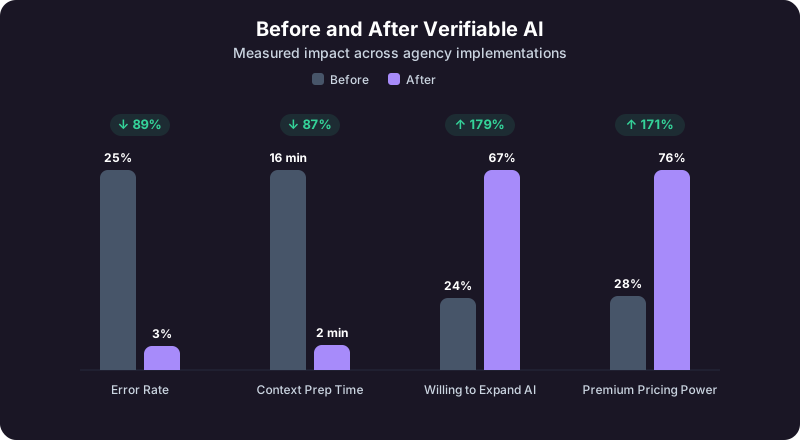
Verifiable AI workflows — where the AI's context sources are explicit and auditable — collapse that preparation time. Instead of spending 15 minutes hunting for and assembling context before every AI interaction, you're spending two. But crucially, the output quality also improves because the AI is working from verified, current information rather than whatever someone remembered to paste in.
The efficiency gain that matters isn't "AI wrote it faster." It's "we stopped spending hours reconstructing context the system should already have."
Pillar 3: Service Expansion
Here's where trust converts directly to revenue.
When clients don't trust AI-assisted work, they limit it to low-risk tasks — first drafts, research summaries, things they'll heavily review anyway. The agency captures efficiency gains on commodity work but can't move AI into higher-value services like strategy, analytics, or client-facing deliverables.
When clients do trust the process — specifically, when they can verify what information the AI used and confirm it's current and exclusive to them — those restrictions dissolve. The same client who only approved AI for blog drafts starts asking whether AI could help with competitive analysis, quarterly reporting, or campaign strategy.
That expansion is the difference between an $8,000 project scope and an $18,000 one — not because you charged more for the same work, but because the client trusted you with more of it.
Pillar 4: Competitive Positioning
The agency market for AI services is getting crowded fast. Everyone claims to "use AI." Very few can show clients exactly how.
Verifiability becomes a differentiator in three specific moments:
- Competitive pitches. "We can show you exactly what context our AI uses for your work" is a concrete claim. "We use the latest AI tools" is not.
- Pricing negotiations. Agencies that can demonstrate a verifiable process face less discount pressure. The client isn't comparing your AI work to a cheaper alternative — they're comparing trusted AI work to an unknown.
- Renewals. When a client has spent months seeing verification proofs and building confidence, switching to an agency with an opaque process feels like a downgrade.
What the Returns Actually Look Like
Let's skip the fabricated study and talk about what the math looks like for a real agency.
Time recovery
If your team currently spends 15 minutes per AI interaction on context preparation, and a verifiable workflow cuts that to 2 minutes, that's 13 minutes back per interaction. For a 10-person agency doing 40 AI-assisted interactions a day, that's roughly 43 hours a week — nearly a full-time equivalent spent on finding information the system should already have.
At a blended rate of $40/hour, that's over $7,000 a month in recovered capacity. Not revenue — capacity. What you do with that time determines whether it shows up on the balance sheet.
Error reduction
Context errors — using outdated information, mixing up client data, missing brand guidelines — are expensive not because of the rework hours (though those add up) but because of the trust damage. One deliverable that references a competitor's old campaign instead of the client's current one can undo months of relationship building.
Verifiable workflows don't eliminate errors entirely, but they make context errors visible before delivery. When you can see exactly what sources the AI used, you catch the wrong-client-document problem in production, not in the client review meeting.
Revenue expansion
This is harder to model because it varies enormously by agency type, client mix, and how well you communicate the change. But the direction is consistent: agencies that give clients visibility into their AI process report that those clients approve broader AI involvement.
If even a third of your clients expand their AI-approved scope by 50%, the revenue impact dwarfs the efficiency savings. McKinsey's research on AI adoption finds that organisations seeing the highest returns from AI are the ones that moved it beyond isolated tasks into core workflows — and that move requires trust.
How Returns Compound
The interesting thing about trust-based ROI is that it compounds in ways efficiency gains don't.
Saving 13 minutes per interaction is valuable in month one. It's exactly the same value in month twelve. But trust builds on itself:
Months 1–2 are about efficiency. Your team gets faster, makes fewer context errors, and starts sharing verification proofs with clients. The financial impact is real but modest — mostly recovered time and reduced rework.
Months 3–4 are about trust. Clients who've seen consistent verification start loosening their restrictions on AI use. Conversations shift from "can we trust this?" to "what else can we use this for?" Service expansion discussions begin.
Months 5–6 are about growth. Expanded scopes translate to larger projects. Improved client confidence translates to better referrals. Competitive pitches start landing because you can demonstrate something concrete that other agencies can't.
Beyond six months, trust becomes part of your positioning. New clients arrive already expecting verifiable AI workflows because a referral told them about it. You stop competing on "we use AI" and start competing on "we use AI you can verify." That's a fundamentally different market position.
Measuring Your Baseline
Before investing in any of this, spend a week measuring what you've actually got:
Time. Track how long your team spends preparing context for AI interactions. Not the AI interaction itself — the setup. If it's consistently over 10 minutes, that's your efficiency case.
Errors. Track context-related mistakes for two to four weeks. How often does AI-assisted work go out with outdated information, wrong client context, or missing guidelines? Each instance costs rework hours and trust.
Trust. Ask five to ten clients a simple question: "On a scale of 1–10, how confident are you that our AI-assisted work uses your current, exclusive information?" If the average is below 6, you have a trust problem that efficiency improvements won't fix.
Restrictions. What percentage of your clients limit which work AI can touch? If more than half restrict AI to low-risk tasks, your trust ceiling is capping your revenue potential.
Once you have those baselines, the ROI projection becomes straightforward. You're not guessing at impact — you're projecting from measured gaps.
The Takeaway
The agencies seeing the strongest returns from AI aren't the ones with the most sophisticated models or the fastest output. They're the ones whose clients trust the process enough to let AI touch their most valuable work.
That trust doesn't come from promises or case studies. It comes from showing your work — literally. When a client can see exactly what context the AI used, verify that it's current, and confirm that nothing leaked from another account, scepticism transforms into confidence. And confidence is what opens budgets.
Efficiency is the floor. Trust is the ceiling. Measure both.