Should You Tell Clients You Use AI?
No law forces you to tell clients you use AI — yet. But contracts, platforms and trust are converging. What to say, plus a template.
Should You Tell Clients You Use AI?
A global consulting firm recently refunded a client hundreds of thousands of dollars after a deliverable turned out to contain AI hallucinations and "slop." Not a startup. A Big Four firm — with armies of quality-assurance people — caught shipping AI-generated garbage to a paying client.
Forrester tells that story in its 2026 B2B predictions, then puts a number on the problem: ungoverned AI in commercial applications will cost B2B companies more than $10 billion in lost enterprise value.
Somewhere in your client list is someone who has read a story like this. Which is why the question eventually lands — in a review meeting, a procurement questionnaire, or a slightly frosty email: "Do you use AI in our work?"
What do you say?
The Honest Legal Answer: Not Yet, But Watch the Direction
Today, in most places, nothing forces you to disclose. There's no general law requiring agencies to tell clients that AI touched their deliverables.
But three forces are converging on that gap:
Regulation is moving. The EU AI Act already introduces transparency obligations for AI-generated content in Europe. Limited in scope today, unambiguous in direction.
Contracts are moving faster. Enterprise procurement teams are adding AI clauses to their agreements — what tools may be used, what data may touch them, what review is required. Forrester's agency predictions note that 85% of US B2C marketing executives plan to review their agencies in 2026 — and AI practice is now part of those reviews.
And the volume is exploding. Forrester predicts employees outside centralised content teams will create two-thirds of B2B content by the end of 2026. Gartner named agentic AI its number-one strategic technology trend for 2026. When everyone's AI generates everything, "we don't use AI" stops being credible. The real question becomes whether your use is governed.
Deloitte's State of AI in the Enterprise found only one in five companies has a mature governance model for AI. Your clients' own AI use is largely ungoverned — and they know it. Which makes them very jumpy about yours.
When only one in five companies governs its AI, your clients already assume the worst about everyone's — including yours. The question isn't whether they trust AI. It's whether they trust you with it.
McKinsey's ongoing AI research keeps landing on the same finding: accuracy and trust concerns are the top barriers to expanding AI use. Clients aren't anti-AI. They're anti-not-knowing.
The Three Moments Disclosure Gets Real
The proposal. Do you mention AI in the pitch? Most agencies don't — it feels like confessing to a shortcut. But the client who finds out later re-reads every deliverable you've ever sent, looking for the tells.
The deliverable. Do you flag AI involvement per piece? Nobody wants a disclaimer stamped on every document. But a client who spots the tell themselves — the oddly formal paragraph, the brand voice that's slightly off — doesn't ask. They assume.
The incident. A junior strategist runs Client B's brief through a chat window that still has Client A's context in it. Nobody knows until Client B asks a pointed question. Now you're reconstructing what happened from memory, in an email, on a Friday afternoon.
The worst part isn't the mistake. It's that you can't answer the follow-up: "what else has AI touched?" With no record of what was used where, every past deliverable becomes a question mark — and the honest answer, "we don't exactly know," is the one the client can't unhear.
And increasingly, there's a fourth moment: the questionnaire. Enterprise clients are sending AI vendor assessments — what tools, what data, what retention, what review. If answering that email takes your team a week of archaeology, that tells you something.
The agencies that answer it well don't improvise. The policy is written down, the tools are listed, the review steps are named — because the work happened before anyone asked. The agencies that scramble are discovering their AI practice and documenting it at the same time, under deadline, for a client who's already suspicious.
Three Levels of Disclosure
Level 1: The contract clause — the floor
One paragraph in your MSA or SOW: AI tools may be used in delivery; client data is handled under your existing data terms; everything passes human review before it ships.
This is the defensive minimum. It makes "you never told us" impossible. Its weakness: nobody reads contracts, and a clause discovered after the fact reads like hiding — even when it isn't.
Level 2: The one-pager — the confident version
A short AI-use policy you actually hand over — in pitches, onboardings, quarterly reviews. What you use AI for (research, drafting, analysis). What you never use it for (final judgment, anything unreviewed). How each client's context is kept separate. Who reviews what before it ships.
Half a page. It reads like competence, because that's what it is.
Level 3: The provenance trail — the strongest
Per-deliverable evidence of what informed the work: which client documents, which versions, which sources. Not a policy — a record.
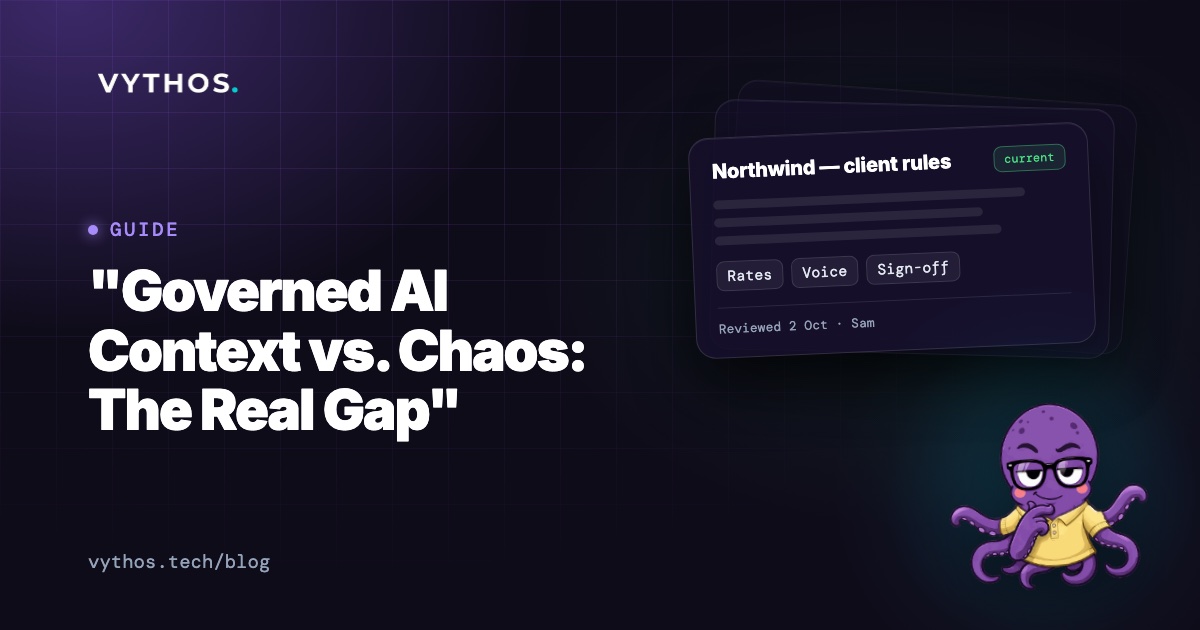
This is what turns disclosure from an admission into a demonstration. When a client asks "did the AI use our latest numbers?", you don't reassure — you show. It's the same dynamic that sits underneath governed versus chaotic context: the difference between saying you're in control and proving it.
What Not to Say
Three disclosure moves that backfire:
The buried clause. A single line on page nine of the contract, never mentioned again. Technically disclosed, practically hidden — and it reads that way when it surfaces. Disclosure the client has to discover is indistinguishable from concealment.
The vague fog. "We may use various technologies to enhance our services." This says nothing and signals everything. Clients who work anywhere near AI read it as "we use AI and we're nervous about it" — which is usually accurate.
The over-promise. "AI never touches client work without human review" — from an agency where juniors paste briefs into chat windows nightly. This is the worst of the three, because it converts a process gap into a lie of record. When the gap surfaces, and it will, the problem stops being AI. It becomes trust.
The Template
Steal this. Adapt the bracketed parts to whatever is actually true for you:
How we use AI. We use AI tools in our research, drafting and analysis work. Every deliverable you receive has been reviewed by [the account lead / a named human] before it reaches you. Your documents, data and brand materials live in a workspace dedicated to your account, and are never used to inform work for other clients. If you'd like to see exactly what information informed any deliverable, ask — we'll show you.
Four sentences. No legalese, no hedging. Put it on one page and attach it to your next onboarding pack. It will do more for the relationship than any capabilities deck.
Two notes on adapting it. First, name the review step honestly — "reviewed by the account lead" means a named person actually reads the work; if your process is "the writer checks their own output," say that instead, and fix the process when you can. Second, the last sentence is the load-bearing one. Offering to show what informed the work only works if you can show it. If you can't today, that's the gap to close — and closing it is cheaper than you think.
One rule before you copy it: only write what you can honour. A disclosure that promises separation you haven't built is worse than no disclosure at all — it's a written record of the gap.
What "Solved" Looks Like
There's a pattern in who handles this well, and it isn't the biggest agencies — they have legal teams to slow everything down and legacy contracts to untangle. It's the small shops: the five-person studios and solo consultants who can write their policy on a Tuesday and hand it to a client on Wednesday. Speed is an advantage here. Use it.
The agencies ahead of this stopped treating disclosure as confession. They treat it as a capability: we use AI, here's how, here's the proof — and that's why the work is worth what it costs. The conversation shifts from "do you use AI?" (suspicious) to "show me how" (curious). And curious clients expand scope — we saw the same pattern in the ROI of verifiable AI, where visibility into the process is what unlocks higher-value work.
Level three is where tooling earns its keep. Vythos keeps each client's knowledge in its own workspace and logs what informed every output, which makes the provenance trail the default rather than a heroic effort. But even without tooling, levels one and two are a day of writing. The honest version of your actual practice beats the polished version of a practice you don't have.
The Honest Trade-Off
Disclosure has real costs. Some clients will say no AI, full stop — regulated industries especially — and you either honour that or walk away. Some will hear "we use AI" and immediately reach for the discount; that's a pricing conversation, and it's coming whether you disclose or not.
And writing the policy forces you to confront the gaps between what you'd like to claim and what you actually do. That discomfort is the point.
The One Thing
Clients aren't asking "do you use AI?" to catch you out. They're asking whether you're in control of it. Disclosure answers with words; proof answers with evidence. The agencies that win this decade won't be the quiet ones or even the honest ones — they'll be the ones who can show their work.