Why Your Agency Needs an AI Operating System (Not Just More AI Tools)
Most agencies are drowning in AI tools but starving for consistency. Here's why true AI adoption requires an operating system, not another app.
Your agency uses AI. Your team uses AI. Your clients expect AI-enhanced work.
So why does it still feel chaotic?
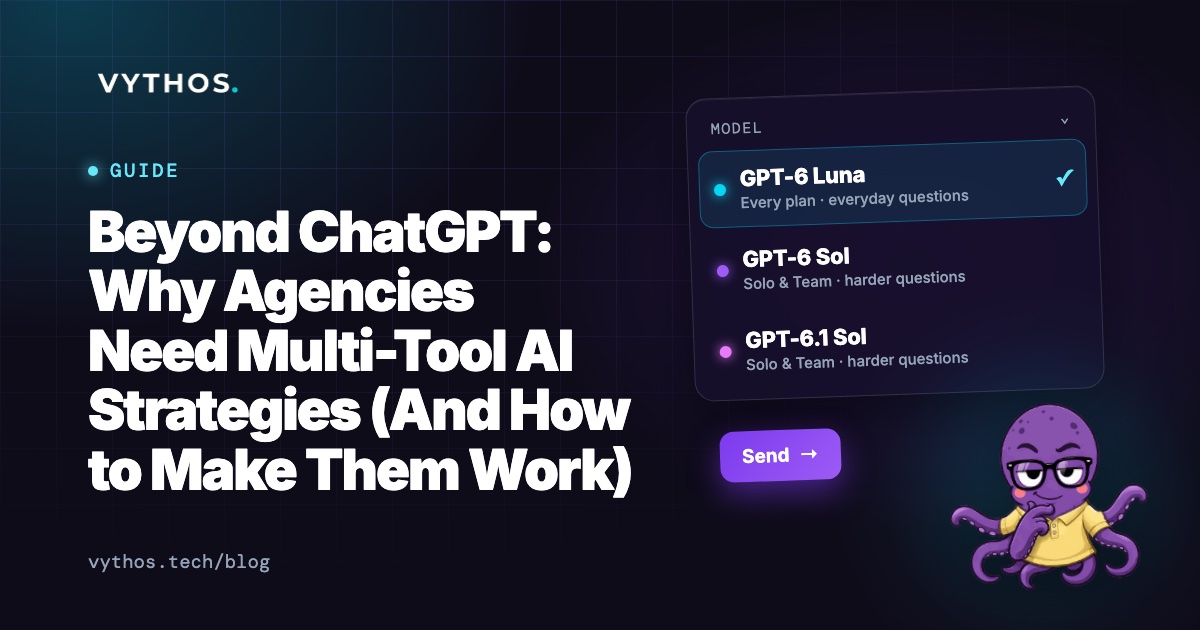
You've got ChatGPT open for copywriting, Claude for strategy, maybe Midjourney for concepts, and everyone's pasting the same client briefs, tone guides, and rate cards into every new conversation. It works... until it doesn't.
The problem isn't that you're not using AI enough. It's that you're using it without an operating system.
The AI Tool Sprawl Problem
Most agencies today look like this: - 5-10 different AI tools in regular rotation - Zero shared context between tools or team members - Manual copying/pasting of client rules, voice guides, and processes - Inconsistent outputs that require extensive editing and rework - Knowledge silos where only certain team members know how to get good results from specific tools
This isn't AI adoption — it's AI fragmentation. And it's costing you more than you realize.
What an AI Operating System Actually Is
An AI operating system isn't another chatbot or image generator. It's the foundational layer that:
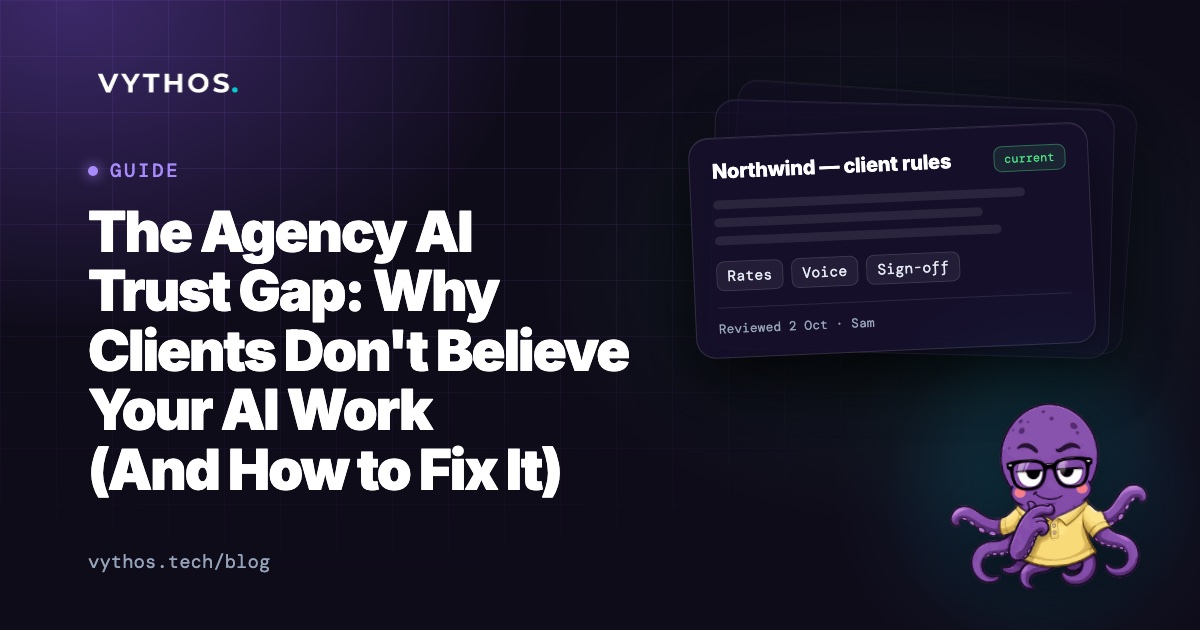
- Centralizes your agency's knowledge — client voices, brand guidelines, rate cards, approval processes
- Distributes that knowledge automatically to every AI tool your team uses
- Maintains version control so when a client updates their terms, every connected tool gets the update
- Provides access controls so junior team members can't accidentally override senior-level decisions
- Creates audit trails so you know exactly what context informed each AI-generated output
Think of it like your agency's operating system for AI — the equivalent of what Windows or macOS does for your local applications, but for your entire AI stack.
Why Point Solutions Fail Agencies
You've probably tried: - Custom GPTs per client — works until you need to share that client's voice across tools - Template libraries — great until someone modifies a template and breaks consistency - Shared documentation — useful but requires everyone to remember to check and paste correctly - Team AI training — effective but doesn't solve the context fragmentation problem
These approaches treat symptoms, not the root cause: context fragmentation.
When your copywriter uses ChatGPT with yesterday's rate card, your strategist uses Claude with last week's tone guide, and your designer uses Midjourney with outdated brand guidelines, you're not leveraging AI — you're amplifying inconsistency at scale.
The Vythos Approach: AI as a Team Sport
Vythos was built specifically for agencies struggling with exactly this problem. Instead of adding another AI tool to your stack, we provide the operating system that makes your existing tools work together seamlessly:
1. Single Source of Truth for Agency Knowledge
Connect your Google Drive, Notion, or upload files once. Vythos becomes the centralized repository for: - Client brand voices and tone guides - Rate cards and payment terms - Approval workflows and sign-off processes - Historical project context and lessons learned - Agency-wide playbooks and standard operating procedures
2. Automatic Context Distribution
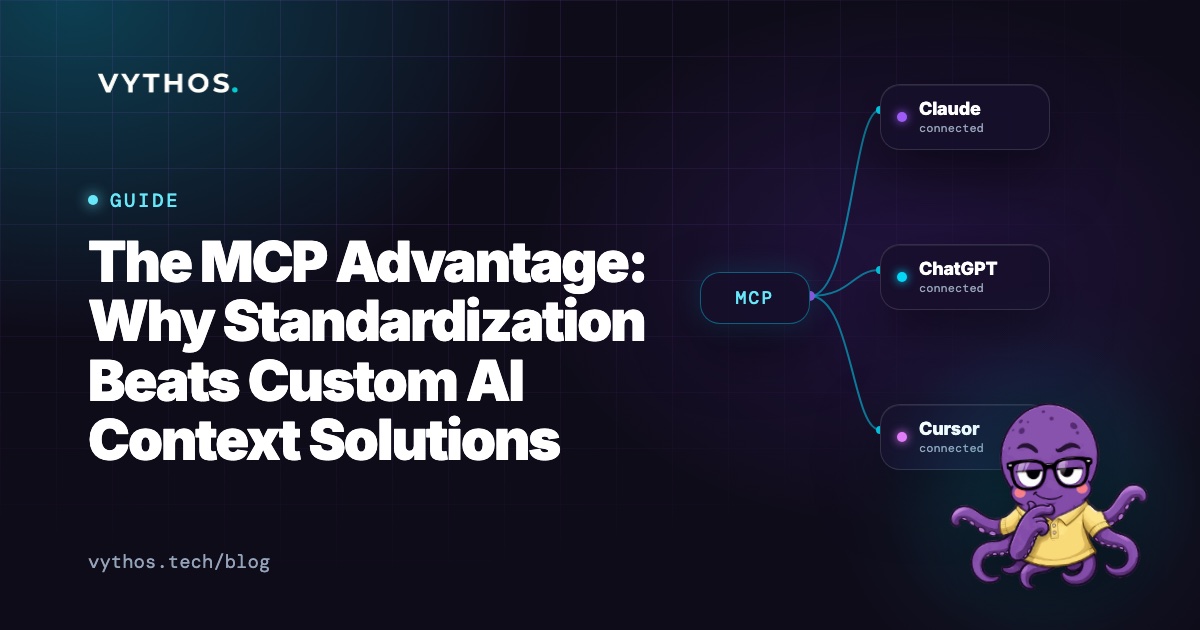
When you connect an AI tool (Claude, ChatGPT, Cursor, etc.) through Vythos' MCP server: - Every request automatically pulls the current, approved context - No more copying/pasting — the AI gets what it needs when it needs it - Updates propagate instantly — change a rate card once, every connected tool sees it - Zero drift between tools — Claude and ChatGPT work from identical context
3. Team-First Access Controls
Different team members need different levels of access: - Junior staff can access approved client context but can't modify core rules - Senior staff can update client information and approve deviations - Account managers can see all client context but only edit their assigned accounts - Leadership gets agency-wide analytics on AI usage and effectiveness
4. Real-World Agency Impact
Agencies implementing Vythos as their AI operating system report: - 60-75% reduction in context-related errors and rework - 40-50% faster client project turnaround times - 3x improvement in output consistency across team members - Elimination of "which version of the client guide was this based on?" questions - Confident scaling of AI usage without quality degradation
Getting Started Without Disruption
You don't need to rip and replace your current AI stack. Vythos works with the tools you already use:
- Connect your knowledge sources (Google Drive, Notion, local files) - 15 minutes
- Define your first client workflow - attach rate card, tone guide, approval process
- Connect your team's AI tools through our MCP server - one-time setup per tool
- Start working - the context flows automatically
The Free plan covers your first client with no time limit, so you can test the approach risk-free. Solo ($29/month) covers all your clients, and Team ($149/month) adds collaborative features and advanced permissions.
The Agencies That Win With AI Won't Have the Most Tools
They'll have the best-connected tools.
In the race to adopt AI, agencies that focus solely on accumulating more AI tools are building houses on sand. The real advantage comes from creating a unified operating system where AI augments your team's expertise instead of creating chaos.
Your agency doesn't need another AI app. It needs an AI operating system.
Connect your first client workflow and see what consistent, scaled AI adoption actually looks like.