Agency knowledge management that your AI can actually use
Agency knowledge is rates, terms, voices and decisions, scattered across docs and inboxes. How small agencies keep it current — and usable by AI.
Ask three people at your agency how you work with a client and you'll get three answers — all of them partly right. The rate card is in a Drive folder, the brand voice is in a deck from last year's rebrand, the decision about who signs off is in an email thread, and the rest is in the account lead's head.
That's normal. It's also expensive, and AI has made it more visible: your team's ChatGPT and Claude chats know even less about the client than your newest hire does.
This is a guide to agency knowledge management for teams of about 3 to 20 people — what to fix, in what order, so your people and your AI tools work from the same, current picture of every client.
What the mess actually costs
The costs rarely arrive as one big bill. They arrive as friction:
- New starters and freelancers take weeks to become useful, because the client's story is scattered across five places and one person's memory.
- Account handovers lose things. The outgoing lead writes a doc; the incoming one learns the real rules from the mistakes that follow.
- AI drafts need heavy editing. Five people prompt five different ways, from five different understandings of the client, and the output shows it.
- Time goes to hunting. A much-cited McKinsey estimate put searching for and gathering information at about a fifth of the knowledge worker's week (McKinsey Global Institute, 2012). The figure is old and broad, but the pattern will be familiar to anyone who has spent twenty minutes finding "the final version" of a rate card.
Why the wiki didn't fix it
Most agencies have tried the wiki — Notion, Confluence, a tidy Drive structure. Storage wasn't the problem. Governance is.
A wiki holds pages; it doesn't tell you which page is the rule, which client it's for, or whether it's still in force. So the wiki fills up with versions, people stop trusting it, and knowledge quietly migrates back into heads and inboxes.
And there's a newer gap: even a perfect wiki does nothing for your AI tools, because they can't read it. Unless the knowledge is connected to the AI at the moment of work, your team is still pasting from it — or prompting from memory.
What good looks like for a small agency
Four principles, in order. None of them needs a big system.
1. One home per client
Every client gets one place that holds their rules: rates, terms, sign-off, voice, banned words, decisions made. Documents, not memory. When someone asks "what do we charge Northwind?", the answer is a document, not a person.
2. House rules separate from client exceptions
Write the agency's defaults once — standard rates, standard terms, your house style. Then record only where each client differs, and make the client's rule win for their work. Two short documents per client beats one long one that mixes both.
3. Every rule has an owner and a date
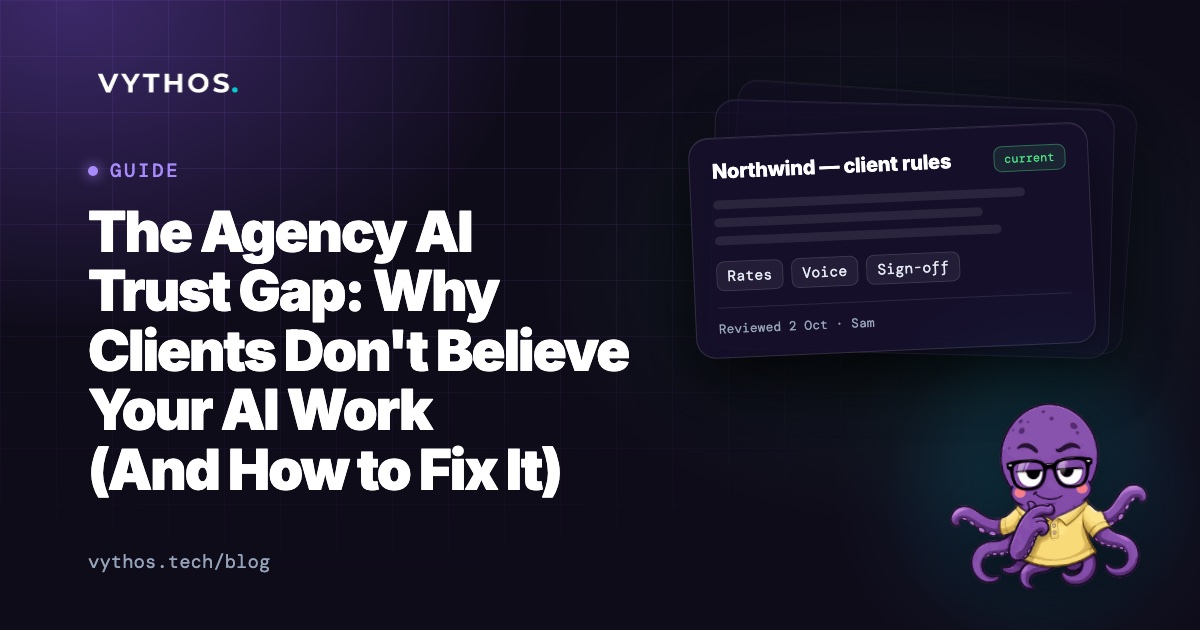
The reason wikis rot is that nobody owns a page. Each client document gets a named owner and a reviewed-on date. When the client renegotiates, the owner edits the document that day — and anything that reads the rule follows.
4. Available at the moment of work — to people and to AI
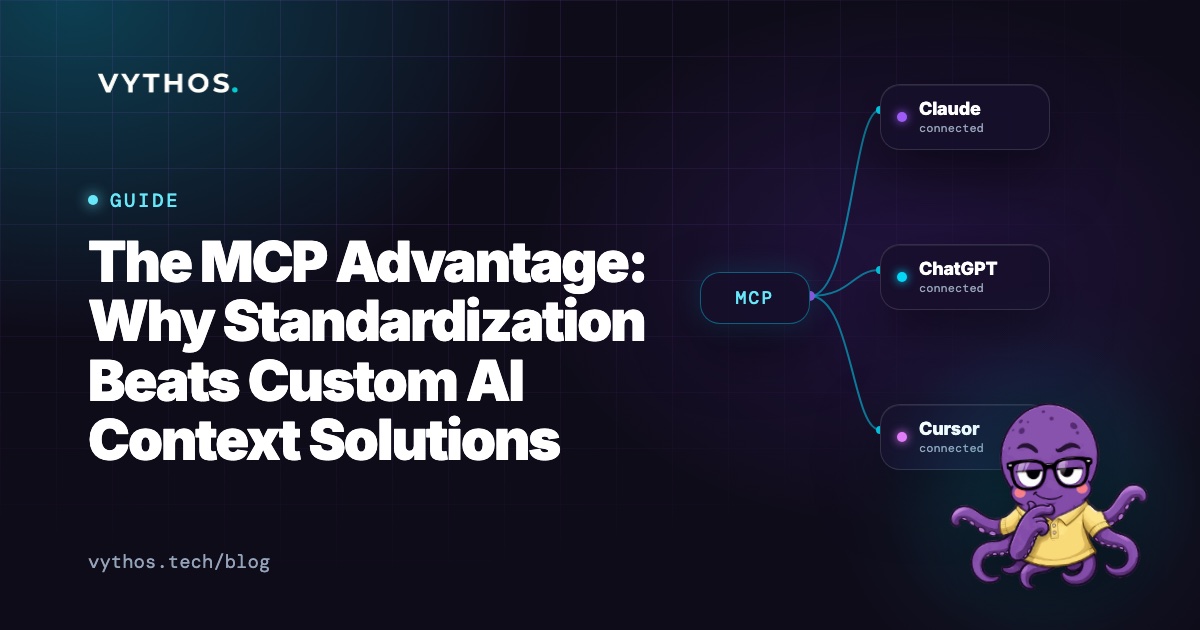
Knowledge that isn't there when the work happens might as well not exist. For people, that means the client's rules are one link away. For AI, it means the tools your team already uses can look the rules up themselves — through an MCP connector to where the rules live, not a paste from whoever remembered.
How Vythos does it
Vythos is built for exactly this: one place where a small agency's client rules live, connected to the AI tools the team already uses.
- Connect your work. Link Google Drive or Notion, or upload files. Everything becomes searchable memory, private to your agency.
- Name your rules. Point Vythos at your rate card, your terms and each client's brand guide. You decide which documents are rules, and which client each one is for.
- Client rules beat agency defaults. Where a client's terms differ from yours, their rule comes first for their work — for everyone on the team, automatically.
- Edit the document, and the rule follows. Update the rate card in Drive and every connected AI tool works from the new version. Old versions are kept, but never sent.
- Every person, every tool, the same rules. Connect Claude, ChatGPT or Cursor once each. Whoever prompts, the answer comes from the same current rules.
Team is $149 a month for the whole agency. And agencies of 3 to 20 people can apply for the Agency AI Grant: $1,000 of credit, a setup call and a direct line to the founders.
Questions agency owners ask
We already have Notion. Is this another wiki?
No — Vythos doesn't replace where your documents live; it connects to it. Notion stays the home of the documents. Vythos is the layer that knows which of them are rules, which client they're for, and sends the current version to your team's AI tools when they work.
How do we stop it going stale like the last system?
The stale problem comes from copies. Here there are none: a rule follows its document, so the only place to update is the document your team already edits. Ownership is still human — you name who owns a client's rules — but there's no second system to keep in step.
Our client information is confidential. Where does it go?
Vythos runs on Microsoft Azure in the EU, doesn't train any AI model on your data, and only sends the context a question needs. The details are on the subprocessors and DPA pages.