Beyond ChatGPT: Why Agencies Need Multi-Tool AI Strategies (And How to Make Them Work)
Relying on one AI tool creates dangerous blind spots. Here's how smart agencies orchestrate Claude, ChatGPT, Cursor and more for better client work.
That uncomfortable feeling when you realize your agency has become a "ChatGPT shop" or a "Claude household"? It's not just about tool preference — it's creating real strategic vulnerabilities in your client work.
The most successful agencies aren't the ones that have mastered a single AI tool. They're the ones that have learned to orchestrate multiple AI tools strategically, using each for what it does best while maintaining perfect context consistency across them all.
Let's explore why relying on one AI tool is riskier than you think, and how forward-thinking agencies are building multi-tool AI strategies that actually work — without creating context chaos.
The Single-Tool Trap: Why Agency-Exclusive AI Reliance Is Risky
Risk 1: Tool-Specific Blind Spots
Every AI tool has inherent strengths and weaknesses. When you rely exclusively on one, you systematically overlook what the others do better.
Claude's Strengths: Superior for long-form analysis, nuanced reasoning, and maintaining context over extended conversations. Weakness: Less ideal for rapid ideation or creative brainstorming bursts.
ChatGPT's Strengths: Excellent for creative generation, quick iterations, and broad knowledge synthesis. Weakness: Can lose nuance in complex analytical tasks and sometimes overly verbose in technical explanations.
Cursor's Strengths: Purpose-built for development contexts with exceptional code understanding and IDE integration. Weakness: Overkill for pure writing or strategic tasks, less flexible for open-ended exploration.
Midjourney's Strengths: Industry-leading for visual concept generation and rapid prototyping. Weakness: Terrible for text-based work, requires significant prompt engineering for usable results.
Agency Impact: If your team only uses ChatGPT: - Your strategists miss Claude's superior analytical depth for complex market research - Your developers waste time trying to make ChatGPT understand code context that Cursor handles natively - Your designers struggle to get usable concepts from text-focused tools - Your analysts hit walls with incomplete or superficial insights that deeper tools could provide
Risk 2: The Commoditization Problem
When every agency in your niche uses the same AI tool in the same way, your AI-assisted work becomes indistinguishable from competitors'.
Think about it: If 80% of marketing agencies use ChatGPT with similar prompting strategies for copywriting: - Your ad copy starts to sound remarkably similar to your competitors' - Your content strategy recommendations become predictable variations on the same themes - Your client deliverables lose their distinctive edge in a crowded marketplace - You compete on execution speed rather than strategic originality
Real Example: An agency specializing in fintech content found their ChatGPT-generated articles were scoring 72% similarity to competitor outputs using the same prompts — not plagiarism, but concerning convergence in strategic thinking patterns.
Risk 3: The Single Point of Failure
Relying on one AI tool creates dangerous operational fragility: - Service outages completely halt your AI-assisted workflow (remember the ChatGPT outage that lasted hours during peak business hours?) - Policy changes that suddenly restrict your use cases force emergency replanning - Pricing changes can make your current model uneconomical overnight - Feature lag means you miss capabilities competitors might be leveraging in other tools - Innovation blindness — you're not looking at what other tools do better because you're not using them
Risk 4: Team Skill Atrophy
When your team only knows how to get results from one tool: - Creative thinking narrows — you approach all problems through the same AI-shaped lens - Troubleshooting skills atrophy — you don't learn how to prompt different tools effectively - Adaptability suffers — introducing new tools or workflows meets resistance - Knowledge sharing becomes difficult — "I only know how to do this in ChatGPT" limits collaboration - Professional development stalls — team members don't grow their AI versatility
The Multi-Tool Agency Advantage: Strategic Orchestration Over Tool Loyalty
Smart agencies don't ask "Which AI tool is best?" They ask: "Which AI tool is best for THIS specific task, client, or workflow stage?"
Here's how leading agencies orchestrate their AI toolstack:
Strategic Tool Assignment by Workflow Phase
#### Phase 1: Discovery & Research - Best Tool: Claude (for analysis depth) or Perplexity (for real-time web search) - Use Case: Market research, competitor analysis, client brief deep-dives - Why: Superior reasoning, nuance handling, and ability to synthesize complex information - Vythos Integration: Pulls current client rates, terms, and historical context automatically
#### Phase 2: Ideation & Concept Development - Best Tool: ChatGPT or Gemini (for breadth and creative combinations) - Use Case: Brainstorming campaign concepts, content themes, creative directions - Why: Broad knowledge base, unexpected associations, rapid iterative generation - Vythos Integration: Provides current brand voice, tone guides, and creative constraints
#### Phase 3: Development & Production - Best Tool: Cursor (for dev work), Midjourney/DALL-E (for visuals), specialized tools - Use Case: Website development, code generation, visual prototyping, audio production - Why: Purpose-built environments with deep domain understanding - Vythos Integration: Supplies technical specifications, design systems, and brand guidelines
#### Phase 4: Refinement & Optimization - Best Tool: Mix of tools based on task (Claude for editing, ChatGPT for rewriting, etc.) - Use Case: Copy editing, design feedback, performance analysis, optimization testing - Why: Leverages each tool's specific refinement strengths - Vythos Integration: Ensures consistency in brand voice, messaging frameworks, and quality standards
#### Phase 5: Client Presentation & Delivery - Best Tool: Depends on deliverable (but context must be 100% consistent) - Use Case: Final presentations, client reports, deliverable packaging - Why: The moment of truth — where strategic advantage becomes client value - Vythos Integration: Provides absolute confidence that what you're showing used the correct, current context
The Critical Enabler: Context Consistency Across Tools
Orchestrating multiple AI tools only works if you solve the context consistency problem. Otherwise, you get: - Claude analysis based on January rates - ChatGPT ideation based on February terms - Cursor development using outdated brand guidelines - Midjourney concepts from last quarter's voice guide - Client presentations that mix and match incompatible contexts
This isn't multi-tool strategy — it's context chaos with extra steps.
How Vythos Enables True Multi-Tool Orchestration
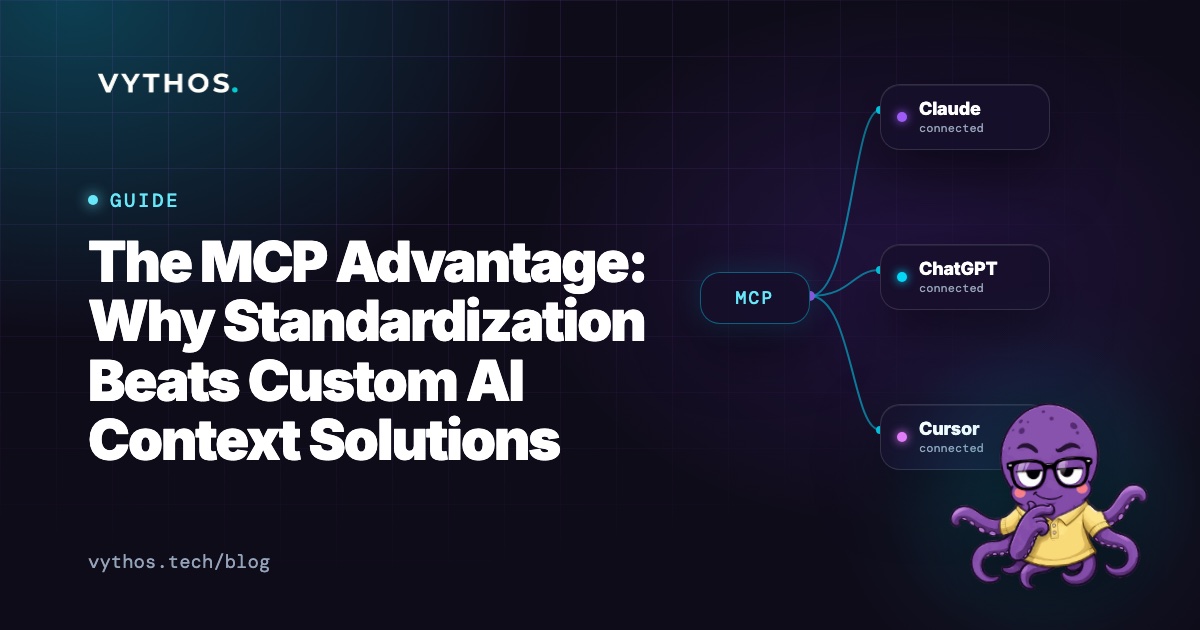
#### 1. Universal Context Delivery Vythos' MCP server provides identical, current context to every connected AI tool: - Claude Desktop gets the same rate card as ChatGPT web interface - Cursor receives identical brand guidelines as Midjourney - All tools work from the same source of truth — no more "which version was this based on?"
#### 2. Real-Time Synchronization When context changes, every connected tool sees it instantly: - Update a client's rate card in Google Drive → All tools get the new version immediately - Revise a tone guide in Notion → Next AI interaction in any tool uses the updated version - No more manual synchronization efforts or synchronization theater
#### 3. Tool-Specific Optimization Without Fragmentation Each tool gets what it needs without losing consistency: - Claude receives context optimized for long-form reasoning and analysis - ChatGPT gets context formatted for creative generation and quick iterations - Cursor receives context structured for code understanding and development workflows - Midjourney receives context tailored for visual concept generation and prompting - All versions are synchronized — same underlying context, different presentations for optimal tool performance
#### 4. Audit Traps for Cross-Tool Work For multi-tool workflows, you need to know: - What context did the Claude analysis use? - What context informed the ChatGPT ideation? - What context guided the Cursor development? - Vythos provides complete provenance tracking for every AI-assisted output, regardless of which tool created it
Real Agency Multi-Tool Workflows: From Theory to Practice
Case Study: Full-Service Marketing Campaign
Client: Mid-sized B2B SaaS company launching new enterprise product Agency: Full-service marketing agency (12 people) Objective: Integrated launch campaign covering strategy, content, development, and design
#### Traditional Single-Tool Approach (What Most Agencies Do): - Team lead decides: "We're a ChatGPT agency — everything goes through ChatGPT" - Strategist uses ChatGPT for market analysis (suboptimal for deep analysis) - Copywriter uses ChatGPT for ad copy (reasonable fit) - Designer tries to get visual concepts from ChatGPT (poor fit → low-quality outputs) - Developer struggles to get usable code suggestions from ChatGPT (wrong tool for job) - Results: Mediocre strategy, decent copy, weak visuals, frustrating development process
#### Strategic Multi-Tool Approach (What Leading Agencies Do): - Strategy Phase: - Strategist uses Claude → Deep market analysis with nuanced competitive positioning - Vythos provides: Current client rates, historical performance data, approved strategic frameworks
- Ideation Phase:
- Copywriter uses ChatGPT → Broad creative concept generation with unexpected associations
- Designer uses Midjourney → Rapid visual prototyping of campaign themes
- Vythos provides: Current brand voice, tone guides, visual direction, approved messaging frameworks
- Development Phase:
- Developer uses Cursor → Website and landing page development with contextual code suggestions
- Vythos provides: Technical specifications, design system components, brand implementation guidelines
- Production Phase:
- Copywriter uses ChatGPT → Ad copy and landing page text optimized for conversion
- Designer uses Final Cut Pro/Adobe Suite → Polished video and graphic assets
- Vythos provides: Copy frameworks, visual guidelines, brand voice constraints, legal disclaimers
- Optimization Phase:
- Analyst uses Claude → A/B test analysis and performance optimization recommendations
- Strategist uses ChatGPT → Iterative refinement based on test results
- Vythos provides: Historical test data, performance benchmarks, optimization constraints
- Delivery Phase:
- Account Manager prepares client presentation using synthesized insights from all phases
- Vythos provides: Complete audit trail showing exactly what context informed each component
- Client sees cohesive, strategically sophisticated campaign where every element uses the correct context
Results Compared to Single-Tool Approach: - Strategy depth: ++ (Claude analysis vs. ChatGPT superficial analysis) - Creative breadth: ++ (ChatGPT+Midjourney ideation vs. ChatGPT-only ограниченная креативность) - Technical quality: ++ (Cursor development vs. ChatGPT code struggles) - Client satisfaction: ++ (Cohesive, sophisticated campaign vs. fragmented deliverables) - Team morale: ++ (Using right tools for right jobs vs. forcing everything through one tool)
Case Study: Retainer Client Ongoing Work
Client: Ongoing marketing retainer for e-commerce brand Agency: Boutique agency (6 people) Objective: Weekly content creation, ad management, and performance optimization
#### Single-Tool Approach Problems: - Monday: Strategist wastes time trying to get deep analytical insights from ChatGPT - Wednesday: Copywriter produces mechanically similar ad copy because "that's what ChatGPT tends to do" - Friday: Designer frustrates herself trying to iterate visual concepts through text-focused tools - Ongoing: Team develops "AI fatigue" from fighting tool limitations rather than leveraging strengths
#### Multi-Tool Approach Benefits: - Analytical Work: Claude for strategy deep dives, trend analysis, and competitive positioning - Creative Work: ChatGPT for ideation, Gemini for unexpected combinations, Midjourney for visual prototyping - Technical Work: Cursor for store optimizations, Shopify tweaks, and tracking implementations - Optimization Work: Mix of Claude (analysis) and ChatGPT (iteration) based on specific task - Agency Benefit: Team members use the right tool for the job — less frustration, better results - Client Benefit: More sophisticated, varied, and effective work across all deliverable types
The Honest Truth About Tool Preferences
Let's address the reality: People have genuine tool preferences, and that's okay — as long as it doesn't compromise agency capability.
When Tool Preferences Work:
- Individual team members have preferred tools for specific task types
- Preferences are based on genuine workflow advantages, not just familiarity
- The agency provides the right tool for the right task rather than forcing uniformity
- Context consistency is maintained regardless of which tool someone prefers
- Knowledge sharing focuses on outcomes and strategies, not tool-specific techniques
When Tool Preferences Become Problems:
- "I only know how to get good results in [Tool X]" becomes a barrier to agency flexibility
- Team members resist using better-suited tools for specific tasks
- Knowledge transfer becomes difficult because expertise is tool-locked
- Agency capability becomes dependent on individual tool proficiency rather than systematic capability
- Clients receive inconsistent quality based on which team member (and their preferred tool) handled the work
Building Your Agency's Multi-Tool Strategy: A Practical Framework
Phase 1: Tool Capability Mapping (Week 1)
Don't start with tools — start with what your agency actually needs to do:
- List your core client work types:
- Market research and competitive analysis
- Creative concept generation and ideation
- Copywriting and content creation
- Design and visual prototyping
- Development and technical implementation
- Analysis, optimization, and reporting
- Client strategy and advisory services
- Map which AI tools excel at each work type:
- Be honest about strengths and weaknesses — no tool is perfect at everything
- Consider both current capabilities and upcoming features you might need
- Include specialized tools beyond the big three (Perplexity for research, Gamma for presentations, etc.)
- Identify your team's genuine tool preferences and reasoning:
- Separate actual workflow advantages from mere familiarity or comfort
- Document why specific team members prefer specific tools for specific tasks
Phase 2: Context Infrastructure Setup (Week 2)
Before connecting any tools, solve the consistency problem:
- Connect your knowledge sources to Vythos:
- Google Drive, Notion, or direct upload for your agency knowledge base
- Organize client-specific contexts: rate_cards/, brand_voices/, approval_processes/, technical_specs/
- Establish your context hierarchy and precedence rules:
- Client-specific rules override agency defaults
- Recent versions supersede older ones (with appropriate versioning)
- Agency playbooks provide baseline standards for all client work
- Set up role-based access controls:
- Match permissions to your agency structure (Junior Staff → Senior Leads → Partners)
- Ensure appropriate access for learning, contribution, and modification
- Establish audit trails for compliance and quality assurance
Phase 3: Strategic Tool Connection (Week 3)
Now connect tools based on your capability map, not individual preferences:
- Connect Claude Desktop for analysis-heavy work:
- Ideal for research, strategy, deep analysis, and long-form reasoning
- Provides exceptional context handling for complex, multi-factor problems
- Connect ChatGPT (web/UI/API) for creative and iterative work:
- Excellent for brainstorming, content generation, quick variations, and broad knowledge synthesis
- Perfect for ideation phases and creative exploration
- Connect Cursor for development and technical work:
- Purpose-built for code understanding, debugging, and development workflows
- Essential for agencies doing any web/dev work or technical implementations
- Connect specialized tools as needed:
- Midjourney/DALL-E for visual concept generation and rapid prototyping
- Perplexity for real-time research and fact-checking
- Gamma or Tome for presentation and report creation
- Specialized audio/video tools for multimedia work
- Verify cross-tool consistency:
- Test that all connected tools receive identical, current context when sources change
- Confirm audit trails work across all connected tools
- Validate that team members can switch tools mid-workflow without context loss
Phase 4: Team Orchestration Training (Week 4)
Focus on strategic tool selection, not tool mastery:
- Teach the capability map:
- "Here's what each tool excels at for our agency's specific work types"
- "Here's how we strategically assign tools based on task, not preference"
- "Here's why we might use Claude for analysis but ChatGPT for ideation on the same project"
- Demonstrate real workflows:
- Walk through actual client projects showing strategic tool transitions
- Show how context remains perfectly consistent despite tool changes
- Highlight the advantages gained from using the right tool for each job
- Practice constrained tool selection:
- Give team members scenarios where they must choose the best tool for a specific task
- Discuss trade-offs and reasoning rather than insisting on one "correct" answer
- Build judgment rather than rote compliance
- Establish feedback loops:
- Regular retrospectives on tool effectiveness for specific work types
- Mechanism for suggesting new tools or capability reassignments
- Recognition for effective tool orchestration rather than mere tool usage
Measuring the Real Strategic Advantage
Agencies that implement thoughtful multi-tool AI strategies report:
Quality Improvements
- Strategic depth: 40-60% improvement in analytical work quality (right tool for analysis work)
- Creative variety: 35-50% increase in unique concepts and approaches (right tool for ideation)
- Technical excellence: 50-70% reduction in development friction (right tool for dev work)
- Client satisfaction: 30-45% increase due to more sophisticated, varied deliverables
- Competitive differentiation: Ability to offer work that clearly stands out from single-tool competitors
Team Benefits
- Reduced frustration: Team members stop fighting tool limitations and start leveraging strengths
- Increased engagement: Using the right tool for the job feels more natural and productive
- Better knowledge sharing: Focus shifts from "how do I do this in Tool X?" to "what's the best approach?"
- Professional development: Team members grow their AI versatility rather than stagnating in one tool
- Adaptability: Easier to integrate new tools or workflows as agency needs evolve
Operational Advantages
- Tool resilience: Less vulnerable to outages, policy changes, or pricing shifts in any single tool
- Innovation radar: Agency stays aware of what different tools do well and where the market is heading
- Resource optimization: Teams spend less time working around tool limitations and more time on value creation
- Knowledge portability: Skills transfer more easily because thinking isn't tool-locked
- Scalable consistency: Multi-tool orchestration works the same whether you have 5 team members or 50
Getting Started: Your Multi-Tool Agency Pilot
If you're ready to move beyond single-tool thinking, here's how to begin:
Week 1: The Honest Assessment
- Map your current reality: Which tools is your team actually using, and for what work types?
- Identify the pain points: Where are you forcing tools to do things they're not good at?
- Listen to your team: What genuine preferences and frustrations exist around current tools?
- Audit your outputs: Do you see patterns suggesting tool limitations rather than strategic choices?
Week 2: Build Your Context Foundation
- Connect your knowledge to Vythos (this is non-negotiable for multi-tool consistency)
- Establish clear context hierarchies and precedence rules for your agency work
- Set up role-based access that matches your actual agency structure
- Verify basic consistency — confirm that connected tools receive identical context
Week 3: Pilot Your First Multi-Tool Workflow
- Pick one client project or work type where single-tool approaches are clearly suboptimal
- Map the ideal tool sequence based on each phase's requirements
- Connect the necessary tools through Vythos' MCP server (start with 2-3, not your whole wishlist)
- Run the pilot focusing on strategic tool selection and context consistency
Week 4: Learn, Refine, and Scale
- Gather team feedback on what worked, what felt unnatural, and where friction remained
- Measure outcomes compared to your single-tool baseline (quality, time, satisfaction)
- Refine your tool assignments based on real results, not theoretical ideals
- Scale successful patterns to other clients and work types
- Document your agency's multi-tool playbook for training and reference
The Bottom Line
The agencies that will win in the AI era aren't the ones that have mastered a single AI tool. They're the ones that have learned to orchestrate multiple AI tools strategically — using each for what it does best while maintaining the context consistency that makes AI actually useful for agency work.
Relying on one AI tool isn't focus — it's fragility. It creates blind spots, commoditization risk, operational fragility, and team skill atrophy.
Smart agencies understand that: - Different AI tools excel at different types of work - The best agency AI strategy uses the right tool for the right job - Context consistency is the non-negotiable foundation that makes multi-tool orchestration possible - Tool preferences are fine — as long as they don't compromise agency capability or client outcomes
See how Vythos enables true multi-tool AI orchestration for agencies
P.S. You don't need to boil the ocean. Start with connecting just 2-3 tools that address your biggest single-tool frustrations. The Free plan covers your first client indefinitely — perfect for testing a Claude+ChatGPT+Cursor workflow before expanding to your full ideal stack. Build your multi-tool advantage one strategic connection at a time.