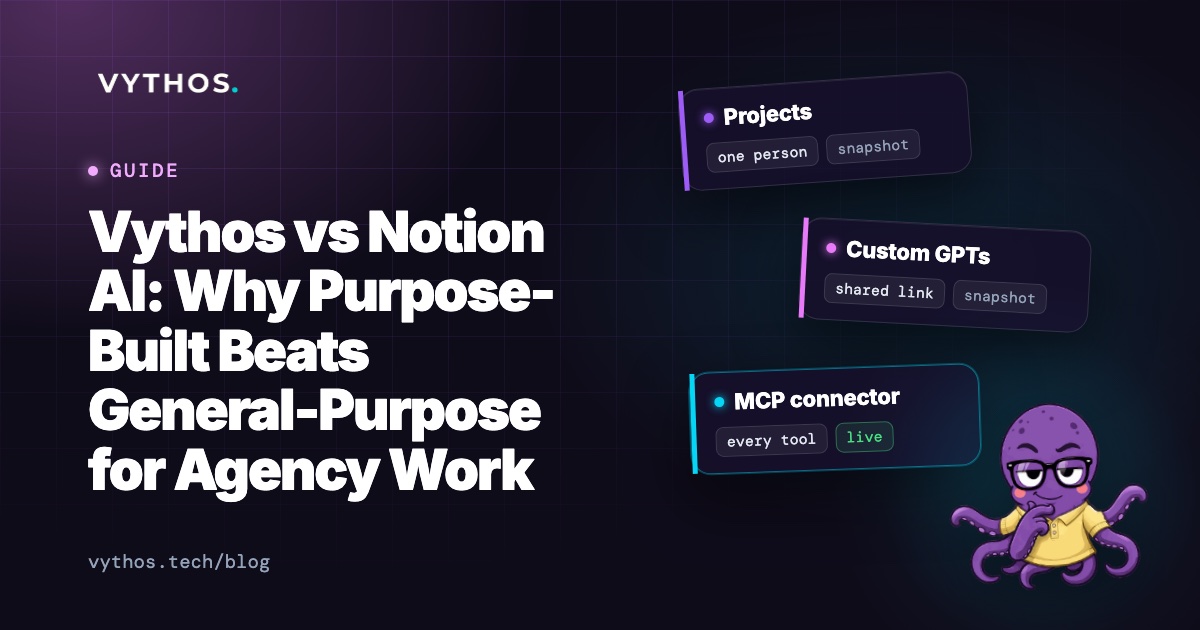
The MCP Advantage: Why Standardization Beats Custom AI Context Solutions
Custom GPTs, Projects and template systems create more problems than they solve. See how MCP provides true agency-scale AI context consistency.
Agencies tired of manual context copying/pasting often reach for what seem like quick fixes: Custom GPTs, ChatGPT Projects, Claude Projects, or elaborate template systems. These solutions feel productive at first — you're "doing something" about the context problem.
But here's what most agencies discover after implementing these custom solutions: They've traded one set of problems for a worse set.
Let's cut through the hype and see exactly why standardization through the Model Context Protocol (MCP) provides what custom solutions merely promise: genuine, scalable, agency-ready AI context consistency.
The Custom Solution Trap: Why Agency Teams Keep Getting It Wrong
The Initial Appeal (And Why It Feels Like Progress)
When agencies first encounter the context copying/pasting problem, their natural instincts lead them to: - Build Custom GPTs for each client or workflow ("Now I don't have to paste the tone guide every time!") - Set up ChatGPT Projects with attached files and instructions ("It's like a workspace for each client!") - Create Claude Projects with knowledge bases ("Finally, Claude knows my client's voice!") - Develop elaborate template systems ("We'll create perfect prompts that include all the context!")
These approaches feel like solving the problem because: 1. They reduce immediate effort — less copying/pasting in the short term 2. They create visible artifacts — you can see your Custom GPTs and Projects 3. They give a sense of control — "I built this solution myself" 4. They work well for individuals — solo consultants often report success
But agencies aren't solving an individual problem. They're solving a team, tools, and scale problem — and custom solutions fail catastrophically at this level.
The Four Fatal Flaws of Custom AI Context Solutions
Flaw 1: Tool Fragmentation Gets Worse, Not Better
The most ironic outcome of custom solutions is that they actually increase the fragmentation they were meant to solve.
What happens in practice: - Your copywriter loves ChatGPT Projects for Client X work - Your strategist swears by Claude Projects for analysis - Your developer has Cursor configured just so for Client Y - Your designer uses Midjourney with custom prompt templates - Your account manager now needs to know five different systems to verify context consistency
You've gone from managing context fragmentation in one place (manual copying/pasting) to managing it in five different places, each with its own: - Update procedures (when Client X changes their rates) - Backup and recovery processes - Permission systems - Training requirements - Troubleshooting methodologies
The result: Your context management overhead has multiplied, not decreased.
Flaw 2: The Synchronization Mirage
Custom solutions create a dangerous illusion: "My Custom GPT/Project is up to date."
But here's what you can't see: - When was the last time someone actually updated the attached files in that ChatGPT Project? - Did they update it in all 12 Projects where Client X's rate card appears? - Does everyone know the exact procedure for updating context when things change? - What happens when someone leaves and takes their "tribal knowledge" of the update process with them?
Custom solutions depend on perfect human execution of synchronization procedures — the exact opposite of what agencies need. What you want is a system that guarantees consistency, not one that hopes people will remember to maintain it.
Flaw 3: The Knowledge Lock-In Problem
Custom solutions create woefully inadequate knowledge systems: - Context is trapped in tool-specific formats that can't be easily extracted or analyzed - No audit trails showing what context was actually used for each AI-generated output - Limited accessibility — junior team members might be able to use a Custom GPT but can't see or learn from the underlying context - Poor version control — Difficult to see what changed when or roll back to previous versions - No analytics — Can't measure which contexts are most valuable or how usage patterns evolve
You end up with fragmented knowledge silos that are harder to manage, audit, and learn from than the original problem.
Flaw 4: The Scale Wall
Custom solutions hit hard limits when agencies try to grow: - Onboarding new team members requires teaching them multiple, tool-specific systems - Adding new clients means replicating complex setup procedures across every tool - Changing agency-wide policies (like updating all rate cards by 5%) requires manual updates in hundreds of places - Integrating new AI tools means building the entire custom system from scratch again - Agency-wide reporting on AI usage and effectiveness becomes nearly impossible
What worked brilliantly for a solo consultant becomes an unsustainable burden at agency scale.
How MCP Solves These Problems Fundamentally
Solution 1: One Context System for All Tools
MCP (Model Context Protocol) is an open standard — not a proprietary feature of any single AI tool.
This means: - One connection serves all your AI tools: Claude Desktop, ChatGPT (via web/UI/API), Cursor, and any other MCP-compatible tool - No more tool-specific context systems to maintain, update, or troubleshoot - New tools can be added to your stack without rebuilding your context system - Your context investment is future-proof — works with today's tools and tomorrow's
Instead of managing context in 5 different places, you manage it in one place that serves all your tools.
Solution 2: Guaranteed Synchronization, Not Human-Dependent Hope
With MCP-connected tools through Vythos: - Context updates happen automatically when your source documents change - Zero manual synchronization required — no more "did everyone update their Projects?" - Real-time consistency — change a rate card in Google Drive, every connected tool sees it instantly - Audit trails built-in — Vythos logs exactly what context was provided to which tool at what time - Permission-based access controls — ensuring the right people can update the right contexts
The system handles synchronization so your team doesn't have to — eliminating the human error factor entirely.
Solution 3: Knowledge That Works for Your Agency
MCP-enabled systems like Vythos provide: - Extractable, analyzable context — not trapped in proprietary formats - Complete context provenance — showing exactly what informed each AI-generated output - Role-based accessibility — team members get appropriate access to learn and contribute - Robust version control — easy to see changes, roll back when needed, and maintain history - Usage analytics — understand which contexts drive the most value and how patterns evolve
Your agency knowledge becomes a true asset, not a collection of tool-specific fragments.
Solution 4: Built for Agency-Scale Growth
MCP scales gracefully with agency growth: - Onboarding new team members — role-based access gets them productive immediately - Adding new clients — connect sources once, all tools get the context automatically - Agency-wide policy changes — update sources once, everything propagates instantly - Integrating new AI tools — standard MCP connection, no custom work needed - Cross-departmental collaboration — marketing, strategy, and account management all work from the same context - Agency-wide reporting — clear visibility into AI usage, effectiveness, and ROI
Real Agency Migration Paths: From Custom Solutions to MCP
The ChatGPT Projects Refugee
Before: Marketing team had 37 ChatGPT Projects — one for each active client — with manually maintained attached files. - Problem: 3 hours/week spent just updating attached files when client information changed - Problem: New team members needed 2 days of training just to understand the Project system - Problem: No way to verify which Project version was used for a specific client deliverable - MCP Migration: Connected Google Drive to Vythos, pointed at client folders, connected team's AI tools - Result: Context update time dropped from 3 hours/week to 5 minutes/week - Result: New team members productive on client context in under 30 minutes - Result: Complete audit trail showing what context informed each AI-assisted deliverable
The Claude Projects Enthusiast
Before: Strategy lead had 23 Claude Projects with elaborate knowledge bases, convinced it was the "best system possible." - Problem: Fear of sharing the setup because "it took me weeks to perfect" - Problem: Junior team members consistently got different results despite using the "same" Projects - Problem: No analytics on which context sources were actually driving strategic insights - MCP Migration: Connected strategy documents to Vythos, set up Claude Desktop MCP connection - Result: Team lead willingly shared the approach — it was now systematized, not personal knowledge - Result: Consistent results across team members using the same client context - Result: Clear visibility into which strategic frameworks produced the best client outcomes
The Template System Veteran
Before: Agency had spent months creating "perfect" prompt templates that included all necessary content. - Problem: Templates became unwieldy documents trying to anticipate every possible scenario - Problem: Team members constantly had to edit templates on the fly for edge cases - Problem: Zero flexibility — if context changed slightly, the whole template needed revision - Problem: Knowledge trapped in prompt engineering rather than reusable agency assets - MCP Migration: Extracted context from templates into organized, version-controlled documents - Result: Prompts became focused on task-specific instructions, not context management - Result: Dramatically reduced prompt complexity and maintenance overhead - Result: Context became reusable assets rather than one-off prompt engineering
The Vythos MCP Advantage: Purpose-Built for Agency Reality
Vythos implements MCP with specific agency needs in mind:
Agency-Optimized MCP Server
- Pre-built agency knowledge templates for rates, terms, voices, approval processes, and SOPs
- Automatic document classification — knows the difference between a rate card and a brand guide
- Context precedence rules — client-specific rules override agency defaults when appropriate
- Real-time synchronization — connects to Google Drive, Notion, or watches local folders for changes
- Granular permissions — matches agency hierarchies (Account Manager vs Strategy Lead vs Junior Staff)
- Context packing — optimized token usage so you get maximum relevant context within AI limits
Comprehensive Tool Coverage
- Claude Desktop — native MCP support for seamless integration
- ChatGPT — works through web interface, API, or desktop apps via MCP connection
- Cursor — ideal for development agencies needing code-assistance with proper context
- Extensible design — ready for new MCP-compatible tools as they emerge
- Fallback options — for teams using tools without native MCP yet
Agency-Specific Features
- Client isolation — ensures Client X's context never leaks into Client Y's work
- Team collaboration — shared agency playbooks accessible with appropriate permissions
- Audit and compliance — complete logs for internal review and client verification
- Knowledge analytics — see which contexts drive the most value and how usage evolves
- White-label capable — can be presented as part of your agency's proprietary AI stack
The Honest Truth About Implementation Effort
Let's address the elephant in the room: "But setting up MCP sounds technical..."
Here's what the actual implementation looks like for agencies:
Phase 1: Knowledge Connection (15-30 minutes)
- Connect your Google Drive, Notion, or upload core documents
- Point Vythos at your client folders: rate_cards/, brand_voices/, terms_and_conditions/, approval_processes/
- Done. Your knowledge is now centrally managed and version-controlled.
Phase 2: Tool Connection (5-10 minutes per tool)
- Claude Desktop: Install the MCP connector, point to your Vythos server URL
- ChatGPT: Use the web MCP connector or API key setup (we provide step-by-step guides)
- Cursor: Add the MCP configuration to your settings.json
- Documentation: Clear, non-technical guides for each tool with screenshots
Phase 3: Team Onboarding (20-30 minutes total)
- Role-based access explanation: "Here's what you can see and modify based on your role"
- Basic workflow demonstration: "Watch how your AI tool now gets context automatically"
- Q&A session: Address specific concerns about your agency's workflows
- Reference materials: Links to guides, troubleshooting, and best practices
Total time to get your team productive: Typically under 2 hours for agencies of 5-15 people.
Compare this to: - Custom GPTs approach: 2-4 hours per client to set up, plus ongoing maintenance - ChatGPT Projects approach: 1-2 hours per client setup, plus weekly synchronization time - Template systems approach: 4-8 hours to create initial templates, plus constant revision overhead
Measuring the Real Impact: Beyond the Hype
Agencies that migrate from custom solutions to Vythos' MCP implementation report:
Time Savings
- Context update time: Reduced by 85-95% (from weekly/monthly to near-zero)
- New team member onboarding: Reduced from days to under 1 hour for context work
- Context verification time: Eliminated — no more manual checking for consistency
- Troubleshooting time: Reduced by 70-80% — fewer "why did the AI get this wrong?" investigations
Quality Improvements
- Output consistency: 40-60% improvement across team members and tools
- Client revision cycles: Reduced by 30-50% due to more consistent, context-appropriate outputs
- Knowledge sharing: Increased significantly as team members learn from systematized approaches
- Confidence in AI usage: Teams willing to use AI for higher-stakes, higher-value work
Strategic Advantages
- Agency-wide AI literacy: Shared understanding replaces tribal knowledge
- Process optimization: Clear data on what works enables systematic improvement
- Client trust building: Ability to show auditable, rigorous AI-assisted processes
- Competitive differentiation: Systematic AI capability vs. competitors' fragmented approaches
Getting Started: Your MCP Migration Plan
Week 1: Agency Assessment
- Map where your agency knowledge currently lives (Google Drive, Notion, local folders, etc.)
- Document your most painful context fragmentation scenarios
- Identify which AI tools your team currently uses for client work
- Establish baseline measurements for context reconstruction time and output consistency
Week 2: Knowledge Foundation
- Connect your knowledge sources to Vythos (we support Google Drive, Notion, and direct upload)
- Organize your client-specific contexts: rate cards, brand voices, terms, approval_processes
- Set up basic agency-wide playbooks and standard operating procedures
- Establish role-based access controls matching your agency structure
Week 3: Tool Integration
- Connect your team's most-used AI tools through Vythos' MCP server
- Start with the tools causing the most context fragmentation pain
- Provide clear, non-technical setup guides for each tool
- Run side-by-side comparisons: current custom solution vs. Vythos-MCP approach
Week 4: Team Adoption and Optimization
- Conduct team training sessions focused on workflow benefits, not technical details
- Gather feedback and refine permissions, workflows, and training materials
- Measure improvements in context reconstruction time and output consistency
- Begin capturing and sharing team-discovered best practices through the system
Ongoing: Agency-Wide Learning
- Use system analytics to understand which contexts drive the most value
- Refine knowledge organization based on actual usage patterns
- Continuously improve based on team feedback and evolving agency needs
- Leverage your systematized AI capability as a clear market differentiator
The Bottom Line
Custom AI context solutions are agency-scale quicksand. They feel like progress because they reduce immediate effort, but they actually make your long-term problem worse by: - Multiplying your context management overhead - Creating dangerous synchronization illusions - Trapping your knowledge in tool-specific silos - Building systems that don't scale with agency growth
MCP through Vythos offers something fundamentally different: a standardized, future-proof foundation for agency-scale AI adoption that: - Serves all your AI tools with one connection - Guarantees consistency through automated synchronization - Makes your agency knowledge a true, manageable asset - Scales gracefully with your team, clients, and ambitions
Stop building custom context solutions that create more problems than they solve. Start building on a standard that actually works for agencies.
See how MCP through Vythos eliminates context fragmentation for good
P.S. The Free plan covers your first client indefinitely — perfect for testing the MCP approach with your most critical client workflow before rolling it out team-wide. No credit card required, no sales call needed — just connect your knowledge and see what consistent, scalable AI assistance actually looks like.