What is MCP? Model Context Protocol, explained for agencies
MCP is the standard that lets Claude, ChatGPT and Cursor connect to outside tools and data. What it is, how it works and why it matters for client work.
Until recently, every AI tool was an island. ChatGPT had its plugins, Claude had its integrations, and if you wanted your AI to see your files, your options were to paste them in or use whatever that one tool happened to support. MCP — the Model Context Protocol — is the industry's answer: one standard way for AI tools to connect to outside systems.
This guide explains what MCP actually is, without the jargon, and what it changes for agencies and freelancers who work across several clients.
The short version
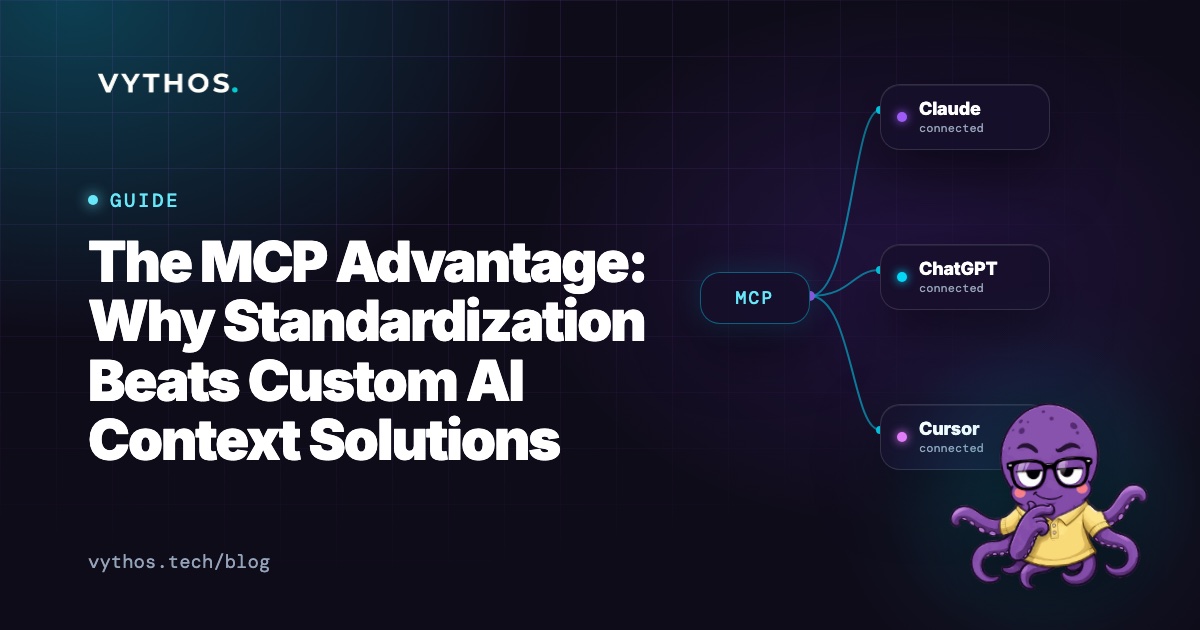
MCP is an open standard, introduced by Anthropic in November 2024, that defines how an AI application connects to external tools and data (Anthropic's announcement). The analogy people reach for is USB-C: before it, every device had its own connector; after it, one plug fits everything. MCP aims to be that plug for AI, and OpenAI, Google and Microsoft have adopted it since.
Two ends make a connection:
- An MCP server offers things the AI can use — looking up documents, searching a database, reading your calendar. Vythos is an MCP server; so is GitHub's, and there are servers for Google Drive, Slack and hundreds of other tools.
- An MCP client is the AI app you already work in — Claude, ChatGPT, Cursor and others — connecting to one or more servers.
What happens when you connect one
Say you connect an MCP server that can read your client documents, and then ask your AI: "What did we agree with Northwind about payment terms?"
- Your AI app sees the server offers a lookup tool, and what it's for.
- The model decides the question needs it, and calls it — you see this happen in the chat.
- The server finds the relevant document and returns it.
- The model answers from what came back, not from a paste or a guess.
The important part is when this happens: at the moment you ask. Nothing was uploaded or attached beforehand. If the document changed this morning, the answer follows this morning's version.
Why it matters for client work
If you work for several clients, MCP changes three things.
One setup, every tool. Without MCP, giving ChatGPT your client knowledge is one project, giving Claude the same knowledge is another, and Cursor is a third. With MCP, one server can feed all of them. You connect each tool once, and they all read from the same source.
Context that stays current. Projects and attached files are snapshots. An MCP lookup reads the live source, so a rate you changed on Tuesday is the rate your AI quotes on Wednesday — in every connected tool.
Separation that holds. A good MCP server doesn't just send documents; it sends the right ones: the rules for the client you're asking about, not every client you have. Done well, one client's details never surface in another's work — our guide to AI for consultants with multiple clients covers why that separation matters.
What MCP is not
MCP is a connector, not a brain. It standardises how your AI reaches outside information; it says nothing about what it reaches.
That gap is where most setups go wrong. Connect an AI to a messy folder through MCP and you get fast, convenient access to a messy folder. Which documents are actually rules? Which client are they for? Which version is in force, and which should be ignored? The protocol doesn't answer those questions. The server you connect to has to.
How Vythos uses MCP
Vythos is an MCP server for your agency's rules and memory. You name the documents that are rules — your rate card, your terms, each client's brand guide — and which client each one is for. When a connected AI tool asks, Vythos sends the current rules for that client and the relevant pieces of your past work, strongest rule first. A client's own rules beat your defaults for their work.
Connecting takes a few minutes in Claude, ChatGPT, Cursor or any tool that accepts MCP connectors, and it's free on every plan — lookups from your AI tools never use your Vythos credits.
Questions about MCP
Is MCP safe for client data?
MCP is a protocol; safety depends on the server you connect. Treat it like any integration: check who runs it, where the data goes and whether it's used to train models. Vythos runs on Microsoft Azure in the EU, never trains on your data, and only sends the context the question needs — not your whole archive.
Do I need to be technical to use it?
No. Connecting an MCP server in Claude or ChatGPT is closer to installing an app than writing code: you add a connector, approve what it can do, and it's there. The Vythos docs walk through it for each tool.
How is MCP different from an API?
An API is a way for software to talk to software — your developer wires each pair of systems together. MCP is a standard layer built for AI apps specifically, so any MCP-compatible AI can use any MCP server without a custom build. One standard instead of a dozen bespoke integrations.