The Hidden Cost of AI Context Chaos
Research shows unmanaged AI costs agencies hours every week. What the data says about context chaos and how to fix it.
The Hidden Cost of AI Context Chaos
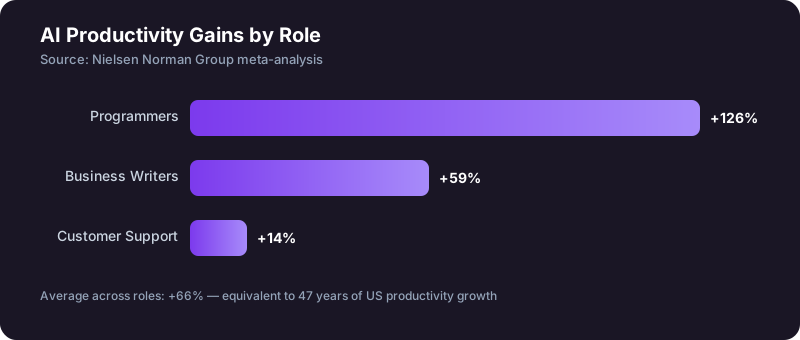
AI makes knowledge workers 66% more productive. That's not a guess. It's the average across three peer-reviewed studies measured by Nielsen Norman Group — covering customer support, business writing, and software development.
So why does it feel like your agency is barely breaking even on AI?
Because productivity gains assume one thing most agencies don't have: good context going in.
The research measures what happens when AI gets the right information at the right time. But in a typical consulting or freelance workflow, the bottleneck isn't the AI. It's the fifteen minutes you spend before every prompt hunting down the client's current rate card, remembering which brand voice version is latest, and hoping you didn't accidentally paste Client B's positioning into Client A's strategy doc.
That gap — between what AI can do and what it actually does for you — is the hidden cost of context chaos. And it's bigger than most people realise.
What the Research Actually Says
The productivity numbers are real, but they come with fine print.
A Stanford/MIT study of 5,179 customer support agents (Brynjolfsson, Li, and Raymond — later published in the Quarterly Journal of Economics, 2025) found that AI-assisted workers resolved 14% more issues per hour on average. Novice workers saw a 34% boost. The researchers attributed this to the AI effectively transferring the knowledge patterns of experienced workers to newer ones.
Nielsen Norman Group's meta-analysis found even larger effects elsewhere:
- Business professionals wrote 59% more documents per hour with AI assistance
- Programmers completed 126% more projects per week
- Customer support agents handled 13.8% more inquiries per hour
The quality went up too. Business documents scored 4.5 out of 7 with AI versus 3.8 without — a statistically significant improvement. The reason? People spent less time on first drafts and more time editing and refining.
These are not small effects. As Jakob Nielsen pointed out, that average 66% gain is equivalent to roughly 47 years of natural US productivity growth, based on Bureau of Labor Statistics baseline figures.
Here's the catch nobody talks about: every one of these studies controlled for context. The AI had the right information. The workers weren't juggling ten different clients in the same chat window. The context was clean.
Your Tuesday afternoon is not a controlled experiment.
Where the Gains Disappear
When Harvard Business School professor Karim Lakhani says AI will lower the cost of cognition the same way the internet lowered the cost of information transmission, he's right. But only if the cognition is pointed at the right information.
For solo consultants and small agencies, this is where things break down. You don't have one client with one context. You have five, ten, fifteen engagements running simultaneously, each with its own rate cards, brand guidelines, tone documents, contractual terms, and historical preferences.
Every time you switch between clients, you're not just switching tabs. You're rebuilding context from scratch.
The Context Reconstruction Tax
Gloria Mark's research at UC Irvine (published in ACM CHI proceedings) found it takes an average of 23 minutes and 15 seconds to fully refocus after a task interruption. That was for regular knowledge work. AI-assisted work adds a layer: you're not just refocusing yourself, you're also refocusing the model.
Here's what that looks like in practice:
- You hunt for context. Where's the latest brand voice doc? Is the rate card in Google Drive, Notion, or that email from March? Did the client update their positioning after Q2?
- You assemble context. Copy-paste the relevant bits. Make judgement calls about what's current. Hope you didn't grab the wrong version.
- You prompt the AI. Finally.
- The AI produces something. It might be great. It might subtly reference the wrong client's terminology because you accidentally left a stale snippet in the conversation.
- You can't prove what happened. The client asks, "Did you use our latest guidelines?" You say yes. But honestly — did you? Can you prove it?
Steps 1 and 2 eat 10-20 minutes per interaction. If you're doing 3-5 AI-assisted tasks a day across multiple clients, that's 30-100 minutes daily just on context preparation. Not thinking. Not creating. Not billing. Just getting the AI to the starting line.
For a solo consultant billing £100/hour, that's £250-500 per week evaporating into context reconstruction. Before a single deliverable ships.
The Five Costs of Context Chaos
It's not just time. Context chaos compounds across five dimensions:
1. The Time Bleed
Asana's Anatomy of Work Index (surveying over 13,000 knowledge workers globally) found that people already spend 60% of their workday on "work about work" — coordination, searching for information, status chasing — rather than the skilled work they were hired for.
AI was supposed to fix this. Instead, for many freelancers and agencies, it added a new category of work about work: context work about AI work. The overhead didn't shrink. It shifted.
2. The Version Roulette
Which brand voice doc is current — the one in your Downloads folder from January, the one a colleague shared in Slack, or the updated version the client emailed last week? Without version control for your client context, every AI interaction is a coin flip.
This isn't hypothetical. If you've ever caught an AI-generated deliverable using outdated pricing, referencing a discontinued product, or writing in a tone the client explicitly moved away from — you've already paid this cost.
3. The Cross-Contamination Risk
This is the one that keeps consultants up at night. You're working on Client A's brand strategy. You switch to Client B's pitch deck. Somewhere in the transition, a phrase, a positioning angle, or a competitive insight bleeds across.
In a traditional workflow, your own memory usually catches these leaks. But when AI is generating volume at speed, cross-contamination can be subtle enough to miss and obvious enough to damage trust.
If you work with clients in the same industry — which most specialists do — this risk scales with every engagement you add. (More on managing multiple client contexts as a solo consultant.)
4. The Audit Void
A client asks: "What information did the AI use to produce this?" You have no answer. Not because you did anything wrong, but because there's no record.
No log of which documents were loaded. No version stamp. No trail showing this deliverable was built on this rate card, this brand voice, this set of specifications — and nothing else.
In regulated industries, this is a compliance gap. In all industries, it's a trust gap. And trust is what keeps clients paying.
5. The Onboarding Wall
You bring on a subcontractor to handle overflow work. Now they need access to every client context you've spent months assembling — your folder conventions, version decisions, the tacit knowledge about which docs are authoritative and which are stale.
Without a system, that handoff is a multi-hour briefing that still leaves gaps. The subcontractor guesses. The client notices.
What "Solved" Actually Looks Like
The agencies seeing real AI productivity gains aren't using better models. They're solving the context problem upstream. Here's the pattern:
Structured context per client
Every client engagement has a defined context space — current documents, version-controlled, with clear boundaries. Not "a folder somewhere." A system that knows this is Client A's world, and nothing from Client B belongs in it.
Context loads before the prompt
Instead of hunting and assembling before every interaction, the right context is already there when you start working. The AI sees the latest brand voice, the current rate card, the active specifications — without you copy-pasting a single thing.
Every interaction is auditable
When a client asks what informed a deliverable, you can show them. Not from memory. From a record. "This deliverable used your Brand Voice v2.3, Rate Card dated September 2026, and the specifications from your Q3 brief. Here's the log."
Context stays current without manual effort
When a client sends an updated document, it replaces the old one. The next time anyone works on that client — you, your subcontractor, your AI — they get the latest version automatically. No announcement email. No "make sure you're using the new one."
This is what protocols like MCP are starting to standardise: a way for AI tools to receive structured, verified context instead of hoping the human assembled it correctly.
The Honest Trade-Off
Setting up proper context management takes effort. You have to organise your client documents, define what's authoritative, and establish a system before the efficiency kicks in.
For a solo freelancer with two clients, the overhead might not be worth it. You can keep it in your head.
For anyone juggling five or more engagements — especially if you're using AI daily and can't afford a context error reaching a client — the maths shifts quickly. That 60% of time spent on "work about work" that Asana measured? Context management is how you start compressing it.
The research is clear: AI with clean context makes people dramatically more productive. AI with chaotic context just makes people dramatically faster at producing things they'll need to check, fix, and apologise for.
The one thing: The productivity gap isn't between people who use AI and people who don't. It's between people whose AI has the right context and people whose AI is guessing. Fix the context, and the gains the research promises start showing up in your actual work.