Shadow AI: The AI Your Agency Can't See
78% of AI users bring their own tools to work — 80% at small companies. Why shadow AI happens, what it costs, and how to bring it into the light.
Shadow AI: The AI Your Agency Can't See
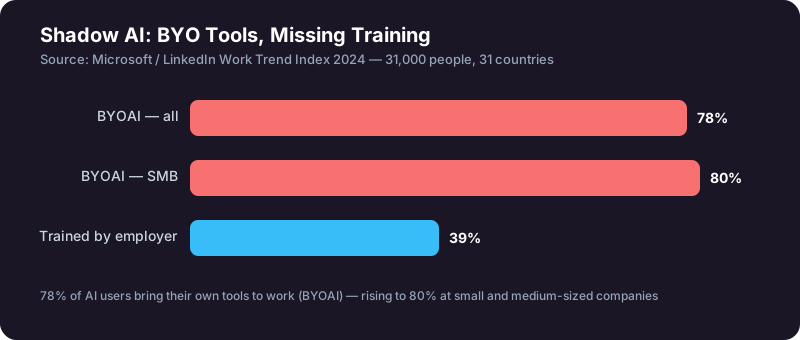
Here's a number that reframes your agency's entire "AI strategy": 78% of people using AI at work brought their own tools. Not the company account. Theirs — a personal ChatGPT Plus, a free Claude login, a Midjourney subscription expensed as "software".
And it's higher where you work. At small and medium-sized companies, the figure is 80%.
If you run a ten-person agency, most of the AI touching your client work is invisible to you. It has a name — shadow AI — and the data says it isn't a fringe behaviour. It's the default.
What the Research Says
The 78% comes from Microsoft and LinkedIn's 2024 Work Trend Index: 31,000 people across 31 countries, plus trillions of Microsoft 365 productivity signals.
The adoption numbers behind it are stark — 75% of knowledge workers now use AI at work, and 46% of them started less than six months before the survey. This didn't roll out gradually. It swept in through the back door during 2024.
Salesforce found the same pattern from the other side. Its Generative AI Snapshot — over 14,000 full-time workers in 14 countries, surveyed with YouGov in late 2023 — found 28% of workers already using generative AI at work, more than half of them without their employer's approval. Another 32% planned to start soon, with or without permission.
Then there's the part that explains why you can't see it:
- 52% of people using AI at work are reluctant to admit using it for their most important tasks
- 53% worry that using AI on important work makes them look replaceable
- 64% have passed off AI-generated work as entirely their own (Salesforce)
High usage, no approval, zero visibility — and half your team thinks their job depends on keeping it that way.
And before you picture Gen Z sneaking tools past their elders: Microsoft's data shows BYOAI cuts across every generation. Meanwhile 60% of leaders admit their own organisation lacks a plan and vision for AI — and leaders' number-one stated concern for the year ahead is cybersecurity and data privacy. Everyone is worried about exactly the thing nobody is governing.
Why Nobody Told You
Shadow AI isn't a character flaw. It's the predictable output of four conditions, all measurable in the same surveys.
The pace is inhuman
68% of people in the Work Trend Index say they struggle with the pace and volume of work; 46% feel burned out. When the deadline is unreasonable and the tool is right there, the tool gets used. Ethics frameworks don't survive contact with a Friday 6pm deliverable.
Nobody trained them
Only 39% of people using AI at work have had any AI training from their employer, and only 25% of companies planned to offer any that year. Salesforce put the never-trained figure near 70%. People are flying a plane nobody taught them to fly — and mostly landing it. Of course they don't advertise the flights.
There's no policy to break
39% of workers told Salesforce their employer holds no strong opinion about AI use at all. You can't violate a policy that doesn't exist — which makes every usage decision a private judgement call, made hundreds of times a week.
The official route is slower
Procurement takes weeks. A personal account takes four minutes. When the sanctioned path is "we'll look into it" and the shadow path is already open in another tab, the shadow path wins. Every time.
And once a personal account holds six months of conversation history and memory, it doesn't just win on speed — it wins on context. The shadow tool knows you. The sanctioned one is a blank page.
What It Looks Like on a Tuesday
No villains in this story — just your best people being resourceful.
Your account manager has a strategy deck due. At 11pm she pastes the brief into her personal ChatGPT Plus — the one she pays for — because it remembers her writing style. The output is good. She edits it, ships it, the client loves it.
Your designer mocks up concepts in a Midjourney account registered to his Gmail. Your subcontractor — the one you hired partly because she's "great with AI" — runs your client's positioning through tools you've never heard of, on accounts you don't know exist.
Nobody did anything malicious. The work is better and faster. But client material is now sitting in consumer-tier accounts you can't audit (we covered what those tiers actually do with your data), nobody can reconstruct which tools shaped which deliverable, and the whole arrangement depends on everyone continuing to be lucky.
And then there's you — expensing a personal Plus account because the company never quite got round to setting up business seats. Shadow AI starts at the top more often than anyone admits.
52% of AI users won't admit to using it on important work. That isn't a statistic about dishonesty. It's a statistic about an environment where honesty feels expensive.
Why the Ban Response Fails
The instinctive fix is prohibition. Samsung ran the most famous experiment: after employees leaked source code and meeting notes to ChatGPT, it banned generative AI on all company devices. JPMorgan, Citi and Goldman Sachs restricted it even earlier.
Look closer at Samsung's move, though. The ban was explicitly temporary — a pause "until these measures are ready", while the company built secure, in-house AI tools of its own. Even the most famous banner in AI history understood that prohibition was a bridge to a sanctioned alternative, not an end state.
It doesn't work as a strategy — for the same reason it didn't work with personal Dropbox accounts in 2012 or WhatsApp in 2018. Bans don't remove the behaviour; they remove your visibility of the behaviour. The pressure that caused it (68% struggling, remember) doesn't go away. People just route around the rule and stop mentioning it. You haven't eliminated shadow AI. You've guaranteed it stays shadow.
Urban planners have the idea of desire paths: the dirt trails worn across grass that show where the pavement should have been. Shadow AI is your organisation's desire path. The right response isn't fencing the grass — it's paving the path.
What "Solved" Looks Like
The agencies getting ahead of this share one move: make the official route faster than the shadow route.
Concretely, that means approved, business-tier accounts where client context is already loaded — so starting in the sanctioned tool is less work than copy-pasting into a personal one. A short written rule about what goes where (the full version is in How to Write an AI Policy for Your Agency). And a norm of talking about AI use openly, because the 52% stay quiet only while honesty feels dangerous.
Start with a census, not an audit. An anonymous survey — what tools are you actually using, for what, no names, no consequences — maps your desire paths in a day. Most founders are surprised twice: once by how much AI is already in use, and once by how relieved people are to be asked.
This is the gap we built Vythos for: the sanctioned route with the client's context pre-loaded, so the fastest way to do the work is also the safe way. When the official path wins on speed, the shadow path dies of neglect.
There's a structural angle underneath it, too. Most agencies run half a dozen AI tools with zero shared context between them — which is exactly what makes the shadow version so attractive. More on that in Your Agency's AI Problem Isn't the Tools.
The Honest Trade-Off
If you're a solo freelancer, you don't have a shadow AI problem — you are the shadow. Everything above applies to your subcontractors instead, and the fix is the written rule plus one awkward question asked before the work starts.
Some shadow usage is also healthy. Experimenting on personal projects is how people build the instincts your agency benefits from.
The goal is visibility over client work, not a surveillance programme — an agency that treats every AI login as an incident will lose exactly the people it most wants to keep.
The one thing: Shadow AI isn't an honesty problem — it's a supply problem. When the official route is slower than the personal one, people route around you. Pave the desire path.