AI for Agencies That Operate at Scale: Beyond the Solo Founder Myth
Most AI advice is for solo consultants. Here's what growing agencies actually need to scale AI adoption without losing quality or control.
Scroll through LinkedIn or Twitter today and you'll find endless advice about using AI for your solo consulting practice. "Here's how to 10x your output as a one-person agency!" "Use these 5 AI prompts to replace your entire team!"
It's compelling content. It's also dangerously misleading if you're trying to build an actual agency — one with multiple team members, standardized processes, client SLAs, and growth ambitions.
The solo founder AI advice ecosystem ignores the realities of agency life: collaboration, quality control, knowledge transfer, and the need to scale systems — not just individual output.
Why Solo Founder AI Advice Fails Agencies
The Illusion of Individual Leverage
Solo founder advice focuses on maximizing individual AI leverage: - "Learn these 5 prompts to do the work of 3 people" - "Use this AI workflow to cut your client delivery time in half" - "Here's how to prompt engineer your way to premium pricing"
For a solo consultant, this makes perfect sense. Your output is your revenue. More individual leverage = more billable hours = more profit.
But for an agency with 5+ people? Individual leverage creates systemic problems: - Inconsistent client experiences — Team member A gets great results with Prompt Set X, Team Member B struggles with Prompt Set Y - Knowledge silos — Only certain people know how to get good AI outputs for certain clients or tasks - Version control nightmares — When Client X updates their brand guidelines, whose responsibility is it to update which prompts in which tools? - Quality degradation at scale — What works brilliantly for one person becomes inconsistent when applied across a team - Training overhead — Every new hire needs to learn not just your clients, but your tribe's specific AI prompting folklore
The Agency Reality: Systems Over Heroics
Agencies don't win by having one AI-powered superhero. They win by building reproducible systems where: - Any qualified team member can deliver consistent, high-quality AI-assisted work - Knowledge transfers smoothly between team members - Updates propagate reliably across the entire organization - Quality standards are maintained regardless of who's doing the work - The system gets better over time through collective learning, not individual heroics
This is the difference between relying on individual brilliance and building institutional capability.
The Four Pillars of Agency-Scale AI Adoption
Pillar 1: Centralized Knowledge, Distributed Access
Solo founders keep their AI knowledge in their heads (or scattered text files). Agencies need it centralized but accessible:
What this means: - Client voices, tone guides, rate cards, and approval processes live in a single source of truth - Every team member accesses the current, approved version when working with AI - Updates happen once and propagate everywhere — no more "did everyone get the memo?" - Access controls ensure junior staff can't accidentally override senior-level decisions
In practice: When your copywriter opens ChatGPT for a client project, they don't need to remember where the latest brand voice guide is stored or whether it's been updated. The system gives them the current, approved context automatically.
Pillar 2: Tool-Agnostic Context Delivery
Solo founders optimize for their favorite AI tool. Agencies need consistency across the tool landscape:
What this means: - Your AI context works the same whether team members use Claude, ChatGPT, Cursor, or other MCP-compatible tools - No more "I can only get good results for Client X in Claude, but ChatGPT keeps messing up the tone" - Team members can choose the best tool for the task without worrying about context fragmentation - New tools can be added to the stack without rebuilding context systems from scratch
In practice: Your strategist can use Claude for deep analytical work while your designer uses Midjourney for concept generation — both pulling from the same current client context without manual intervention.
Pillar 3: Permission-Based Collaboration
Solo founders don't need access controls. Agencies need sophisticated permission systems:
What this means: - Different team roles get different levels of context access and modification rights - Account managers can see all context for their clients but can't edit agency-wide playbooks - Senior staff can approve temporary deviations from standard processes for special projects - Junior staff work within guardrails that ensure quality and consistency - Full audit trails show exactly what context informed each AI-generated output
In practice: When onboarding a new account manager, you don't need to teach them your tribal AI knowledge. You give them role-appropriate access to the system, and they can start delivering consistent work immediately.
Pillar 4: Continuous System Improvement
Solo founders improve through individual experimentation. Agencies improve through systematic learning:
What this means: - The system captures what works and what doesn't across the entire team - Successful patterns get codified and made available to everyone - Failed experiments teach the system (not just individuals) what to avoid - The agency's collective AI effectiveness increases over time - New hires inherit the accumulated wisdom of the team, not just individual tips and tricks
In practice: When someone discovers a particularly effective way to prompt for client research outputs, that pattern gets added to the shared knowledge base where everyone can benefit — not just kept as that person's "secret sauce."
The Hidden Advantage: Predictable Scaling
Agencies that implement these four pillars gain something solo founder advice can't provide: predictable scaling.
With centralized knowledge, tool-agnostic delivery, proper permissions, and continuous improvement: - You know exactly what quality level to expect when adding new team members - Client onboarding becomes systematic rather than tribal knowledge transfer - You can confidently take on more complex AI-enabled projects - Pricing becomes more predictable because output consistency reduces revision cycles - The agency's AI capability becomes a selling point rather than a point of variability
What This Actually Looks Like: A Day in the Life
Before Agency-Scale AI Systems
Sarah (Copywriter, 2 years experience): - Spends 15 minutes finding/pasting/verifying client context before each ChatGPT session - Has developed personal "cheat sheets" for 3 of her 8 clients (not documented anywhere) - Sometimes gets told her outputs "don't quite sound like Client X" and needs to revises - Worries about taking on new clients because she's already at capacity managing context
Mike (Strategy Lead, 4 years experience): - Uses Claude almost exclusively because "ChatGPT never gets the tone right for our financial services clients" - Has built an elaborate personal Claude Projects system that took weeks to configure - Is reluctant to share his setup because "it's my competitive advantage" - Spends significant time helping junior team members reproduce his Claude results in other tools
Jenna (Account Manager, 18 months experience): - Constantly asks team members "Did you use the latest brand guidelines for Client Y?" - Spends hours in QA checking whether AI outputs used current vs. outdated context - Feels like she's the human context synchronization layer for the team - Wishes she could spend more time on actual account strategy and less on context policing
After Implementing Agency-Scale AI Systems
Sarah (Copywriter): - Opens ChatGPT and instantly gets current, approved client context - Focuses entirely on creative execution rather than context management - Can confidently take on new clients knowing the system handles context consistency - Spends her energy on crafting better copy, not chasing down documents
Mike (Strategy Lead): - Uses whichever tool is best for the task (Claude for analysis, ChatGPT for ideation, etc.) - Knows every tool will provide the same current, accurate client context - Shares effective prompting patterns with the team through the system's knowledge base - Focuses on strategic insights rather than tool-specific context management
Jenna (Account Manager): - Spends zero time verifying context — the system guarantees it's current and correct - Can focus on client relationship growth, opportunity identification, and strategic account planning - Uses system analytics to see which clients are getting the most value from AI assistance - Spends her time on high-value account strategy rather than context policing
The Vythos Approach: Built for Agency Reality
Vythos was designed specifically for agencies that need to scale AI adoption — not just maximize individual leverage. Our approach addresses each of the four pillars:
1. Centralized Knowledge Platform
- Connect Google Drive, Notion, or upload files once — becomes your single source of truth
- Automatic version control ensures everyone works from current, approved context
- Granular permissions let you control who can view, edit, or approve different types of knowledge
- Full audit trails show context provenance for every AI-assisted output
2. Universal MCP Context Delivery
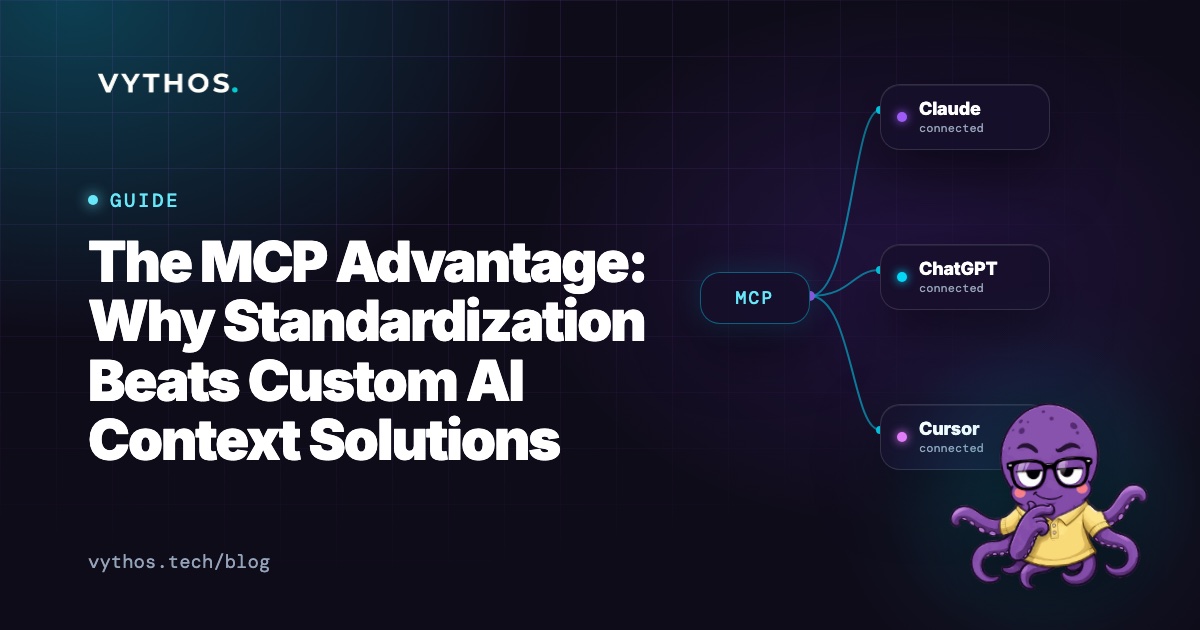
- Industry-standard Model Context Protocol connects to Claude Desktop, ChatGPT, Cursor, and other MCP tools
- No more tool-specific context systems — one connection serves all your AI tools
- Real-time synchronization means updates propagate instantly across your entire AI stack
- Works with the tools your team already prefers — no forced migrations or retraining
3. Sophisticated Role-Based Access Control
- Pre-built agency roles (Account Manager, Creative Lead, Strategy Lead, Junior Staff, etc.)
- Custom role creation for unique agency structures and workflows
- Context inheritance rules — team members get appropriate access based on client assignments and roles
- Temporary access grants for special projects or client-specific initiatives
- Read-only vs. edit permissions at the document and folder level
4. Team Learning and Knowledge Capture
- System captures effective prompting patterns and workflows discovered by team members
- Successful patterns get suggested to others working on similar tasks
- Failed experiments teach the system what to avoid (without blaming individuals)
- Agency-wide analytics show which AI applications deliver the most value
- New hires benefit from the collective learning of the team from day one
Getting Started: From Solo Founder Tactics to Agency Systems
Phase 1: Foundation (Weeks 1-2)
- Audit your current state — Map where agency knowledge lives, how context flows today, and where the pain points are
- Connect your knowledge sources — Google Drive, Notion, or upload core documents to establish your single source of truth
- Define your first 3-5 client workflows — Rate cards, tone guides, approval processes, and standard operating procedures
- Set up basic roles and permissions — Match to your current agency structure
Phase 2: Team Integration (Weeks 3-4)
- Connect your team's AI tools — Claude Desktop, ChatGPT (via web/UI or API), Cursor, and other MCP tools
- Run parallel effectiveness tests — Compare current context reconstruction methods vs. Vythos-provided context
- Train team members on the new workflow — Focus on what changes (less context management) and what stays the same (creative and strategic work)
- Gather feedback and adjust — Refine permissions, workflows, and training based on real team usage
Phase 3: Optimization and Scaling (Ongoing)
- Measure effectiveness improvements — Track time saved on context work, output consistency gains, and client satisfaction
- Capture and share team discoveries — Effective prompting patterns, workflow innovations, and lessons learned
- Expand to additional clients and use cases — Leverage the system's scalability to take on more complex AI-enabled work
- Continuously refine based on agency-wide learning — Let the system get smarter as your team uses it
The Competitive Advantage Nobody Talks About
In an AI-powered agency landscape, the real competitive advantage isn't: - Who has the most expensive AI tools - Who can prompt engineer the most effectively - Who has the founder with the deepest AI knowledge
The real advantage belongs to agencies that: - Can deliver consistent, high-quality AI-assisted work regardless of which team member is doing it - Can onboard new team members and have them producing consistent AI-assisted work quickly - Can scale AI usage across more clients and more complex projects without quality degradation - Can turn AI from a variable cost center into a predictable, scalable capability
This is what agency-scale AI adoption looks like. It's less glamorous than solo founder AI heroics, but it's infinitely more valuable for building an actual business.
Build your agency's AI operating system — where individual talent meets systematic consistency to create real agency-scale AI advantage.
P.S. The Free plan covers your first client indefinitely — perfect for testing the approach with your most important client workflow before rolling it out team-wide.